
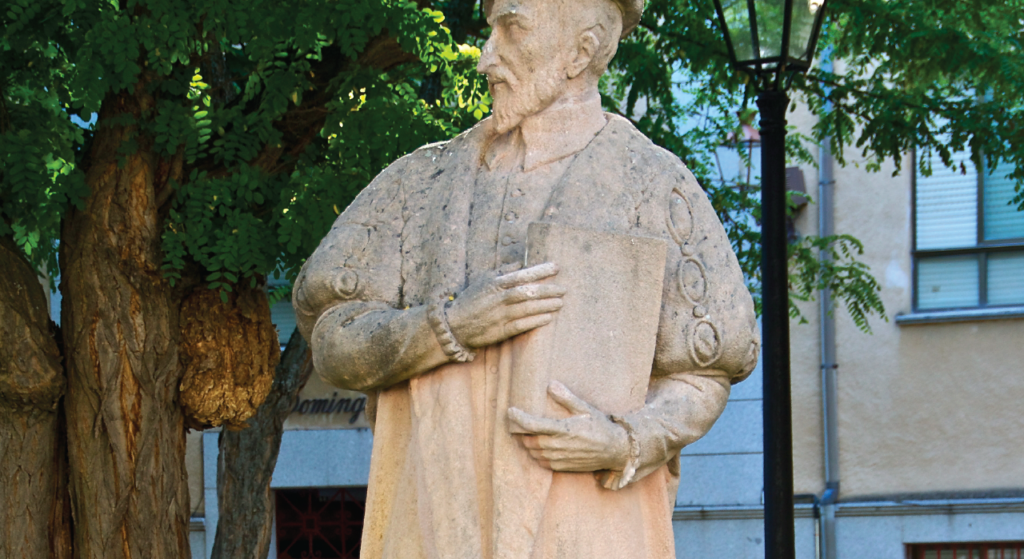
1) His Biography
Andrés Laguna de Segovia (1499–1559) was one of the most distinguished Spanish humanists, physicians, and botanists of the Renaissance. Born in Segovia, Castile, he grew up during a period when Spain was rapidly emerging as a global power and a centre of intellectual exchange. Laguna’s early education took place in his hometown, but his intellectual curiosity soon led him to the University of Salamanca, where he studied philosophy and the liberal arts. It was there that he became immersed in the revival of classical knowledge that defined the early sixteenth century. His early exposure to Greek and Latin texts would later prove essential to his medical and botanical translations, especially those from classical authors such as Dioscorides and Galen.
Following his initial studies in Salamanca, Laguna travelled to Paris, where he pursued medicine and natural philosophy at the University of Paris—one of Europe’s leading centres of learning at the time. The French capital exposed him to a cosmopolitan network of scholars, physicians, and philologists. He earned his Doctor of Medicine degree there, and his years in France broadened his understanding of anatomy, botany, and pharmacology. Laguna became fluent in several languages, which allowed him to access and interpret ancient manuscripts with exceptional precision. His Parisian years were also formative in shaping his humanistic approach to science, which sought to unite empirical observation with textual scholarship.
After completing his studies, Laguna travelled extensively throughout Europe, spending time in Flanders, Italy, and Germany. His travels allowed him to observe diverse flora and medicinal practices across regions, which he would later integrate into his scientific writings. In Italy, he interacted with prominent physicians and scholars in Rome, Ferrara, and Venice, cities that were then flourishing under the influence of Renaissance humanism. These encounters not only deepened his medical expertise but also inspired him to translate and comment upon ancient botanical texts, aiming to correct the numerous errors perpetuated through centuries of transcription and translation.
One of the most important episodes in Laguna’s life was his work in translating De Materia Medica, the foundational pharmacological treatise written by the Greek physician Dioscorides. His Spanish translation and commentary, published in 1555, became one of the most celebrated scientific works of the sixteenth century. Laguna’s version was not merely a translation but a profound reinterpretation enriched by his own botanical experience and European travels. The work revealed his capacity to merge linguistic erudition with empirical botanical knowledge, a combination that made him a key figure in Renaissance science and medicine.
Throughout his career, Laguna served as a physician to many high-ranking figures, including Emperor Charles V and Pope Julius III. His reputation for both intellectual sophistication and practical medical skill earned him significant prestige in European courts. He was also called upon to serve as a medical adviser and public health reformer, writing treatises on the purity of water and the prevention of plague. His dual identity as a court physician and scholar placed him at the intersection of science, politics, and religion—an intersection he navigated with remarkable tact and balance.
Laguna’s later years were marked by his continued dedication to scholarship. He maintained correspondence with scholars across Europe and continued to refine his understanding of botany and medicine. His interest in the natural world was always connected to a moral and philosophical vision: he saw nature as a manifestation of divine wisdom, and the study of plants as both a scientific and spiritual endeavour. Even as he aged, he remained committed to teaching and mentoring younger scholars, ensuring that his humanist legacy endured beyond his lifetime.
He returned to Spain after many years abroad, bringing with him a wealth of knowledge and manuscripts. In his final years, he focused on perfecting his commentaries and preparing his collected works for publication. He died in 1559 in Guadalajara, leaving behind a rich intellectual legacy that bridged the medieval and modern approaches to science. His contributions profoundly influenced Spanish and European medical thought, setting the stage for later botanists and physicians to adopt a more empirical and critical approach to nature.
Andrés Laguna’s life stands as a testament to the Renaissance ideal of the homo universalis—a man who united deep learning with practical science, linguistic mastery with medical innovation. Through his translations, travels, and teaching, he became a key conduit between classical antiquity and modern scientific inquiry, embodying the synthesis of humanism and empiricism that defined his age.
2) Main Works
Pedacio Dioscorides Anazarbeo, Acerca de la Materia Medicinal y de los Venenos Mortíferos (1555)
This is Andrés Laguna’s most celebrated and enduring work—a Spanish translation and commentary on the Greek physician Dioscorides’ De Materia Medica. Far more than a literal translation, Laguna’s version integrates extensive notes based on his own botanical and medical observations from across Europe. He corrected numerous errors found in earlier Latin versions and added over six hundred annotations, illustrations, and comparative references to plants and remedies known in his own time. The work became the authoritative pharmacological text in Spain and its territories for centuries, shaping the study of botany and medicine throughout the Spanish-speaking world.
Anatomica Methodus (1535)
Written during his time in Paris, this early work reflects Laguna’s growing interest in anatomy and his efforts to synthesise classical knowledge with the emerging empirical methods of Renaissance medicine. In this treatise, he outlines a systematic approach to anatomical dissection, emphasising the importance of direct observation rather than blind adherence to textual tradition. The Anatomica Methodus marks his departure from medieval scholasticism towards a more modern scientific framework and anticipates later developments in anatomical science that would culminate in the work of figures like Vesalius.
De Aqua Theriacali Disputatio (1543)
This treatise explores the composition and therapeutic uses of “theriacal water,” a compound medicine derived from ancient pharmacology and often associated with the antidote known as Theriac. Laguna analyses its ingredients, preparation methods, and purported healing properties, comparing ancient recipes with contemporary practices. He subjects these remedies to empirical scrutiny, discussing their physiological effects and dosage with remarkable precision. The work reveals his skill in combining philological analysis with medical experimentation, and his willingness to challenge long-held assumptions about traditional remedies.
Compendiaria Expositio super Canonem Avicennae (1546)
In this Latin commentary on Avicenna’s Canon of Medicine, Laguna demonstrates his deep engagement with both Islamic and classical sources of medical knowledge. He praises Avicenna’s logical structure and diagnostic insights while also identifying areas where ancient authorities lacked anatomical or botanical accuracy. The Compendiaria Expositio was written to guide students of medicine in understanding complex medical doctrines, helping to bridge the gap between medieval Arabic medicine and the emerging European scientific methods of the sixteenth century.
De Antidotis Liber (1551)
This work delves into the preparation, classification, and efficacy of antidotes and compound medicines. Laguna offers detailed analyses of various antidotes, both ancient and contemporary, providing commentary on their pharmacological properties and clinical applications. He often compares ancient formulations with those he personally tested, revealing his preference for experiential validation over theoretical speculation. The De Antidotis Liber stands as a crucial text in understanding Renaissance pharmacology and the transition toward evidence-based medicinal practices.
Tratado de las Peste (1556)
Written amid recurrent outbreaks of plague in Europe, this Spanish treatise reflects Laguna’s public health concerns and his efforts to apply medical knowledge for societal benefit. He discusses the origins, symptoms, and contagion mechanisms of the plague and proposes preventive measures such as quarantine, sanitation, and the purification of air and water. The text combines Hippocratic theory with Renaissance civic awareness, presenting medicine as a moral duty as well as a scientific pursuit. It also displays Laguna’s pragmatic and humane approach to epidemic management.
Discurso Breve sobre la Cura y Preservación de la Peste (1558)
A shorter and more accessible companion to his Tratado de las Peste, this work was intended for practical use by physicians and civic officials. Laguna condenses his recommendations for preventing and treating plague into clear, concise guidance. He advocates for personal hygiene, proper ventilation, and the use of specific herbal concoctions. Beyond its medical content, the text illustrates his belief in disseminating scientific knowledge for the common good, reflecting the Renaissance humanist conviction that education and medicine should serve society at large.
Annotations on Galen’s Writings (Unpublished, Circulated in Manuscript)
Laguna’s annotations on the works of Galen, though never formally published, were widely circulated among scholars and students in manuscript form. These commentaries reveal his critical engagement with Galenic medicine, as he frequently compared Galen’s theories with the empirical evidence he gathered through clinical and botanical observation. His notes show an early move towards a comparative, interdisciplinary understanding of medicine that valued experimentation alongside textual authority. Together, these manuscripts highlight the full scope of Laguna’s intellectual range and his lasting influence on Renaissance medical thought.
3) Main Themes
Humanism and the Revival of Classical Knowledge
A defining theme in Andrés Laguna’s works is his deep engagement with humanism and the rediscovery of classical medical and botanical texts. As a scholar trained in the Renaissance tradition, Laguna sought to revive and clarify the wisdom of ancient authorities such as Dioscorides, Galen, and Avicenna. However, unlike many of his contemporaries, he approached these classical sources not as immutable truths but as living bodies of knowledge open to correction and reinterpretation. His annotated translation of De Materia Medica epitomises this attitude—he used his philological skill to restore the accuracy of ancient texts while incorporating his own observations from nature. In doing so, he advanced the humanist principle that true learning involved both fidelity to classical thought and critical engagement with contemporary experience.
Laguna’s humanism was also moral and philosophical, not merely linguistic or scholarly. He believed that studying medicine and botany was an exercise in understanding divine creation and that the physician’s role extended beyond treating disease to promoting wisdom and balance in human life. His writings show how scientific inquiry, when guided by ethical and intellectual humility, could serve as a path to both personal enlightenment and the betterment of society. Thus, Laguna’s humanism united science, ethics, and language in a way that defined much of Renaissance intellectual life.
Empirical Observation and Experimental Method
Another central theme across Laguna’s works is his insistence on empirical observation as the foundation of medical and botanical knowledge. He repeatedly emphasised that direct study of nature—through travel, fieldwork, and dissection—was superior to reliance on textual authority alone. His scientific approach was evident in his detailed commentary on plants, antidotes, and diseases, which often included descriptions of specimens he personally examined across Europe. This empirical stance marked a turning point in early modern science, moving away from the scholastic traditions that had dominated medieval medicine.
Laguna’s experimental sensibility is particularly visible in works such as De Antidotis Liber and De Aqua Theriacali Disputatio, where he tested traditional remedies and compared their effects with ancient claims. His readiness to challenge the assumptions of Galen or Dioscorides when evidence demanded it shows an emerging modern scepticism. Yet, his experiments were never divorced from moral reflection; observation, for Laguna, was not only a tool for discovery but also an act of intellectual honesty. This balance between faith in ancient knowledge and reliance on personal experience made him one of the pioneers of empirical medical methodology in the Iberian Renaissance.
The Relationship between Medicine and Morality
Laguna’s writings often reflect his conviction that medicine is inseparable from ethics. He viewed the physician not simply as a healer of the body but as a guardian of moral and civic health. In his plague treatises, such as Tratado de las Peste and Discurso Breve sobre la Cura y Preservación de la Peste, he framed public health as a collective moral responsibility. The doctor’s duty extended beyond curing illness to preventing its spread and educating the populace about hygiene and prudence. His tone in these works often blends medical instruction with pastoral care, urging compassion, discipline, and civic cooperation.
This ethical dimension of medicine also manifests in his belief that natural knowledge was a divine gift to be used wisely and humbly. Laguna condemned greed, ignorance, and superstition as obstacles to good medical practice, arguing that a virtuous physician must cultivate both technical skill and moral character. His integration of ethical reasoning into scientific discourse exemplifies the Renaissance view that knowledge was most valuable when it served the common good.
The Unity of Botany and Medicine
A key intellectual contribution of Laguna’s work was his insistence on the inseparability of botany and medicine. He viewed plants not merely as objects of curiosity but as essential tools for healing and understanding the human body. His translation of Dioscorides reflects this philosophy, as he meticulously describes each plant’s medicinal properties, habitat, and method of preparation. He believed that true medical mastery required familiarity with the natural world and that botany was the foundation upon which pharmacology should rest.
This unified vision also reflects Laguna’s interdisciplinary approach to science. His botanical studies were never detached from their therapeutic context, and his pharmacological analyses were grounded in close observation of plants in their natural environment. By linking the physical characteristics of flora with their medicinal efficacy, he contributed to a holistic understanding of medicine that influenced both herbalism and academic botany. His approach helped establish the scientific groundwork for later botanical classification systems in Europe.
The Role of Language and Translation in Science
Laguna’s career as a translator and commentator underscores his belief in the transformative power of language in scientific communication. He understood that mistranslations or corrupt manuscripts could distort centuries of medical knowledge, and he approached translation as both an intellectual and moral duty. His Spanish version of De Materia Medica aimed to make ancient pharmacology accessible to readers beyond the Latin-speaking elite, thereby democratising scientific learning.
Moreover, his linguistic precision was accompanied by a cultural sensitivity to how meaning evolved over time. Laguna often noted regional variations in plant names, medicinal practices, and measurements, showing his awareness of linguistic diversity as a scientific problem. For him, translation was a bridge between worlds—ancient and modern, learned and popular, Latin and vernacular. His meticulous approach to language established standards for scholarly accuracy and helped stabilise scientific terminology in Spanish, influencing generations of physicians and botanists.
Public Health and Preventive Medicine
Laguna’s engagement with plague treatises reveals his forward-looking vision of public health as an organised, preventive discipline. Long before the germ theory of disease, he recognised the importance of sanitation, clean water, and air purification in maintaining communal well-being. His recommendations for quarantine, hygiene, and dietary moderation show his pragmatic approach to medicine, combining Hippocratic theory with civic responsibility.
He was among the earliest European physicians to articulate a systematic concept of prevention, arguing that health should be preserved through education and governance rather than merely restored through treatment. Laguna’s public health writings positioned him as both a scientist and a reformer, concerned with how knowledge could be translated into practical measures to protect society. His holistic view of medicine, in which environmental and social factors played crucial roles, anticipated many principles of modern epidemiology and preventive healthcare.
The Moral and Aesthetic Value of Nature
Underlying all of Laguna’s work is a profound reverence for nature as a reflection of divine order and beauty. He perceived botanical study not only as a scientific task but as a spiritual contemplation of creation. This view emerges throughout his commentaries, where descriptions of plants often merge precision with poetic admiration. For Laguna, to study nature was to engage with the wisdom of God made visible in the world’s design.
This aesthetic and moral appreciation of nature also reinforced his scientific curiosity. His passion for collecting, identifying, and classifying plants stemmed from both intellectual discipline and wonder. In this sense, his work embodies the Renaissance spirit that united science and art, reason and devotion. By blending empirical rigour with moral reflection, Andrés Laguna de Segovia helped shape a vision of science that was not merely technical but deeply humanistic—a vision that would resonate far beyond his century.
4) Segovia as a Botanist
As a botanist, Andrés Laguna de Segovia stands among the most significant figures in sixteenth-century natural science, bridging the transition between medieval herbals and the emerging empirical methods of modern botany. His work exemplified the Renaissance synthesis of classical erudition and firsthand observation, and his translations and commentaries profoundly shaped botanical understanding in the Iberian world. Laguna was not content merely to reproduce the knowledge of earlier authorities; he reinterpreted them through his own study of plants across Europe. His approach to botany was practical, observational, and deeply humanistic, grounded in a belief that the careful study of nature could reveal divine wisdom while advancing human health.
Laguna’s most celebrated botanical achievement remains his annotated translation of Dioscorides’ De Materia Medica (1555), which set a new standard for botanical scholarship. Unlike prior translators, who focused only on linguistic accuracy, Laguna incorporated detailed commentary based on plants he had personally examined during his travels in France, Italy, and the Low Countries. He compared Dioscorides’ descriptions with local species, noted their habitats and medicinal applications, and corrected centuries of accumulated textual and botanical errors. In this way, his work became both a scientific treatise and a botanical travelogue, blending classical authority with Renaissance fieldwork. His insistence on direct observation positioned him among the early advocates of empirical botany.
Laguna’s botanical method combined literary scholarship with natural history. He recognised that botanical knowledge was deeply intertwined with language and culture, and he worked to stabilise plant nomenclature by cross-referencing ancient, medieval, and vernacular names. His commentaries include meticulous notes on the linguistic variations of plant terms between Greek, Latin, Arabic, and regional dialects, helping later botanists identify species more accurately. This philological precision was essential in an age before standardised taxonomy, and Laguna’s work served as a precursor to the classificatory systems that would later be developed by naturalists such as Linnaeus.
In his botanical studies, Laguna also displayed a strong sense of regional ecology and geography. He frequently remarked on the influence of soil, climate, and altitude on plant growth and potency, demonstrating a proto-ecological awareness rare in his time. By comparing Mediterranean flora with plants from northern Europe, he identified the adaptability of certain species and their varied medicinal qualities. This geographic sensitivity reflected his belief that botany should not be confined to texts or gardens but should encompass the dynamic relationship between plants and their environments. His holistic understanding of botany laid the groundwork for later scientific treatments of plant distribution and ecology.
Laguna’s field observations were closely tied to his medical practice. For him, the study of plants was never an abstract pursuit but a foundation for pharmacological knowledge. Each plant carried both curative potential and moral significance, embodying what he perceived as nature’s inherent order. His descriptions often emphasised the healing virtues of herbs, roots, and seeds, detailing their preparation and dosage with a precision that combined practical experience with literary elegance. This integration of botany and medicine made his works indispensable to physicians, apothecaries, and naturalists throughout the Spanish-speaking world for centuries.
Furthermore, Laguna’s botanical writing reflects a distinct ethical and aesthetic dimension. He approached the natural world with reverence, describing plants not only for their medicinal uses but also for their beauty and symbolic resonance. His prose often evokes wonder at nature’s complexity and harmony, reinforcing the Renaissance belief that studying the natural world could cultivate virtue and understanding. This attitude distinguishes Laguna from purely utilitarian herbalists, situating him within a broader philosophical tradition that viewed nature as both a source of knowledge and a moral guide.
Laguna also contributed to the dissemination of botanical science beyond elite academic circles. By writing his major works in Spanish rather than Latin, he made complex botanical and pharmacological ideas accessible to a wider audience of practitioners, students, and educated laypeople. His choice of language was both scholarly and civic—an effort to democratise scientific knowledge in the service of public welfare. Through this, he helped establish a vernacular scientific vocabulary that would influence later Spanish naturalists and medical writers.
Andrés Laguna de Segovia’s botanical legacy lies in his capacity to unite observation, language, and ethics into a coherent vision of natural science. He elevated botany from a secondary branch of medicine to a discipline of its own intellectual dignity, grounded in direct experience and moral reflection. His De Materia Medica translation became a cornerstone of Renaissance botanical literature, guiding European and colonial botanical studies for generations. As both a physician and a natural philosopher, Laguna helped redefine how humans understood their relationship with the plant world—transforming botany from an inherited body of lore into a critical, empirical, and deeply humanistic science.
5) His Legacy
The legacy of Andrés Laguna de Segovia is one of enduring influence across the fields of medicine, botany, and humanist scholarship. He occupies a distinctive place in the intellectual history of the Renaissance as a figure who bridged the classical and modern worlds through a synthesis of philology, observation, and scientific curiosity. His writings not only advanced botanical and pharmacological knowledge but also redefined the ethical and linguistic foundations of scientific inquiry. Laguna’s work exemplified the Renaissance ideal that true learning combined textual mastery with direct engagement with nature—a legacy that resonated long after his death and helped shape the intellectual landscape of early modern Europe.
In the realm of botany, Laguna’s greatest contribution was the revival and transformation of Dioscorides’ De Materia Medica. His Spanish translation and commentary became the most influential botanical and pharmacological text in the Hispanic world for over two centuries. It served as both a scientific reference and a model of humanist scholarship, blending accurate linguistic reconstruction with empirical botanical detail. Through his meticulous corrections and personal observations, Laguna set new standards for botanical description and verification. His work circulated widely throughout Europe and the Spanish colonies, contributing significantly to the transmission of Mediterranean botanical knowledge to the New World.
Laguna’s influence extended far beyond technical botany. He was instrumental in the development of a vernacular scientific tradition in Spain, writing in accessible yet elegant Castilian at a time when most scientific discourse remained confined to Latin. This choice reflected his conviction that knowledge should serve society as a whole rather than a small intellectual elite. By bringing medical and botanical understanding into the public domain, he inspired generations of Spanish physicians, naturalists, and apothecaries to pursue science in their own language. His translation became a foundational text in the history of Spanish scientific prose, admired for both its clarity and literary grace.
As a physician, Laguna also left a moral and professional legacy grounded in his humanistic worldview. He conceived of medicine as a discipline inseparable from ethics and civic responsibility. His plague treatises, for example, reveal an early understanding of public health principles and a deep concern for the well-being of communities. His call for cleanliness, quarantine, and education anticipated many of the preventive measures that would later form the basis of modern epidemiology. By linking medical practice with compassion and public service, he helped define the Renaissance physician as both a healer and a moral agent.
Laguna’s impact was also felt in the evolution of scientific method. His insistence on direct observation and experimentation, combined with his critical attitude toward ancient authorities, anticipated the empirical spirit of the seventeenth century. He questioned received wisdom without rejecting its intellectual heritage, thus embodying the transitional spirit of Renaissance science—a blend of respect for tradition and commitment to discovery. His work influenced later scholars who continued to refine the balance between textual authority and experimental verification, an approach that would eventually culminate in the scientific revolutions of the following centuries.
Culturally, Laguna helped to bridge the intellectual exchanges between Spain and the rest of Europe. His years abroad, particularly in France and Italy, made him an important conduit for the transmission of humanist and medical ideas between regions. His writings circulated among international scholars and were cited in numerous botanical and medical works across the continent. In this way, he contributed to Spain’s participation in the wider European scientific renaissance, helping to integrate Iberian scholarship into the broader intellectual currents of the sixteenth century.
Laguna’s legacy also endures in the symbolic sense—as a model of the homo universalis, the universal man of learning who sought harmony between faith, reason, and empirical knowledge. His vision of science was not purely mechanistic but moral and aesthetic, rooted in the belief that studying nature was a way of understanding the divine order of creation. This integration of scientific precision and spiritual reflection set a tone for later Spanish natural philosophers, many of whom looked to Laguna as a guiding example of how to unite intellect with integrity.
Today, Andrés Laguna de Segovia is remembered as one of the greatest botanists and physicians of Renaissance Spain—a scholar whose work transcended his own era to influence both European and colonial scientific traditions. His meticulous scholarship preserved and revitalised classical learning, while his humanist principles helped shape the ethical and linguistic foundations of modern science. Through his writings, translations, and moral vision, he transformed the study of nature into a discipline that was at once empirical, philosophical, and profoundly human. His legacy endures as a testament to the enduring power of knowledge pursued with curiosity, humility, and a commitment to the common good.