
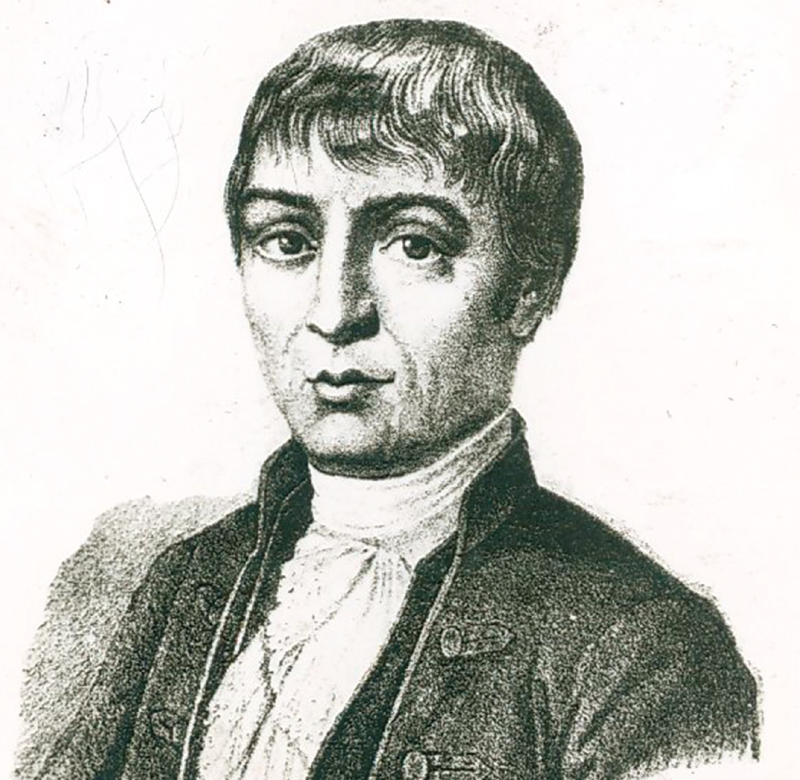
1) His Biography
Hipólito Ruiz López was born on 8 August 1754 in Belorado, a small town in the province of Burgos, Spain. His early life coincided with the height of the Spanish Enlightenment, a period in which science and rational inquiry began to reshape intellectual and political life in the Iberian Peninsula. From an early age, Ruiz showed an aptitude for the natural sciences, particularly botany and medicine. He pursued his education in Madrid, studying at the Reales Estudios de San Isidro, where he was exposed to the growing influence of Linnaean taxonomy and Enlightenment thought. His teachers, many of whom were followers of the modern scientific methods promoted by the Spanish Crown, encouraged him to apply reason and observation in the study of the natural world — principles that would later define his career.
After completing his studies in Madrid, Ruiz became closely associated with Casimiro Gómez Ortega, a prominent botanist and director of the Royal Botanical Garden of Madrid. Under Ortega’s mentorship, he honed his skills in plant classification, illustration, and field observation. Ruiz’s academic achievements and growing reputation led to his appointment as a key member of the Royal Botanical Expedition to the Viceroyalty of Peru and Chile, which was commissioned by King Charles III in 1777. The expedition’s mission was to explore and document the vast and largely unstudied flora of South America, an endeavour that represented both a scientific and imperial enterprise for Spain. Ruiz, at just twenty-three years old, was appointed the expedition’s chief botanist — a remarkable distinction that reflected his promise and the trust placed in his scientific abilities.
In 1778, Ruiz, accompanied by fellow botanist José Antonio Pavón, pharmacologist Joseph Dombey, and a team of assistants, embarked on the long and perilous voyage to South America. Upon arrival, they established their base in Lima before undertaking extensive journeys through the Andes, exploring regions such as Huánuco, Tarma, and Chinchao. These areas, rich in biodiversity, presented both extraordinary opportunities for discovery and formidable physical challenges. Ruiz and his team faced tropical diseases, extreme weather, and treacherous terrain, yet they remained steadfast in their mission to collect and classify plant specimens. Their work was among the earliest systematic attempts to document South American flora through European scientific methods.
Ruiz’s time in the Andes proved to be both productive and transformative. Over the course of ten years, the expedition collected more than 3,000 plant specimens and produced over 2,000 detailed botanical illustrations. Among their most significant discoveries were new species of Cinchona — the source of quinine, a crucial treatment for malaria — as well as many ornamental and medicinal plants unknown in Europe. Ruiz’s careful field notes, observations of native plant uses, and interactions with local healers enriched the scientific record, combining empirical observation with cultural insight. This synthesis of European taxonomy and indigenous knowledge became a hallmark of his approach to natural history.
In 1788, after a decade of exploration, Ruiz returned to Spain with an immense collection of specimens, seeds, and drawings. The journey back was fraught with danger: a fire during their voyage destroyed part of the collection, and political instability in Spain delayed the proper cataloguing of the surviving materials. Despite these setbacks, Ruiz and Pavón began the painstaking process of classifying and publishing their findings. Their work was officially recognised and supported by the Spanish Crown, which saw in it a means of enhancing imperial prestige through scientific achievement. Ruiz’s return marked the beginning of a new phase in his career — one focused on publication, teaching, and consolidation of his research.
In Madrid, Ruiz dedicated himself to organising and publishing the expedition’s results, which culminated in the monumental Flora Peruviana et Chilensis. This multivolume work, co-authored with José Antonio Pavón, became one of the most significant contributions to eighteenth-century botany, describing and naming hundreds of new species. Ruiz’s writing combined precision in description with aesthetic sensibility in presentation, demonstrating his commitment to both science and art. The publication also positioned Spain within the global scientific community, countering the dominance of British and French botanical exploration during that era.
Despite his scientific triumphs, Ruiz’s later life was marked by personal and professional difficulties. He struggled with bureaucratic obstacles, conflicts over credit for his discoveries, and health problems that stemmed from years spent in harsh tropical environments. Nevertheless, he continued to teach and write, contributing to the education of new generations of Spanish botanists. His correspondence reveals a man deeply committed to scientific truth, often frustrated by institutional politics but never disillusioned with the natural world that had captivated him since youth.
Hipólito Ruiz López died in Madrid on 8 May 1816, leaving behind a legacy that bridged continents and disciplines. His work transformed European understanding of South American flora and established the foundation for future botanical research in the region. Though his name is sometimes overshadowed by his contemporaries, his meticulous methods, exhaustive documentation, and devotion to empirical science secured his place among the great naturalists of the Enlightenment. His life’s journey — from the classrooms of Madrid to the peaks of the Andes — remains a testament to the spirit of exploration and intellectual curiosity that defined his age.
2) Main Works
Flora Peruviana et Chilensis (The Flora of Peru and Chile)
This monumental work, co-authored with José Antonio Pavón, is the most significant achievement of Hipólito Ruiz López’s career and one of the great botanical publications of the eighteenth century. Published in several volumes between 1798 and 1802, it systematically catalogued the plants collected during the Royal Botanical Expedition to Peru and Chile. The work included detailed descriptions of over 3,000 species, many of which were new to European science, and was accompanied by hundreds of exquisite botanical illustrations. Each entry provided taxonomic details, morphological observations, and notes on habitat and uses. The Flora not only expanded scientific knowledge of South American botany but also helped establish Linnaean classification as the standard in Spain’s colonial science.
Quinología o Tratado del Árbol de la Quina (Quinology, or Treatise on the Cinchona Tree)
Published in 1792, this treatise focuses on one of Ruiz’s most important areas of study — the Cinchona tree, from which quinine is derived. The work provides an in-depth examination of the species, its varieties, habitats, and medicinal properties, based on Ruiz’s extensive fieldwork in the Peruvian Andes. It was among the earliest European works to describe the differences between various species of Cinchona and their respective potency in treating malaria. The treatise combined medical, botanical, and economic perspectives, demonstrating how scientific research could serve both public health and imperial interests. Quinología played a crucial role in refining European understanding of quinine and influenced pharmacological practices across the continent.
Relación Histórica del Viaje a los Reinos del Perú y Chile (Historical Account of the Journey to the Kingdoms of Peru and Chile)
This semi-narrative account offers an overview of the Royal Botanical Expedition’s activities from its departure in 1778 to its return to Spain in 1788. Blending scientific observation with travel writing, Ruiz described the expedition’s routes, encounters, hardships, and major discoveries. The Relación Histórica serves as both a documentary record and a reflection on the intellectual and physical challenges of scientific exploration. Ruiz’s detailed account of the expedition’s methods and experiences provides valuable insights into the daily realities of Enlightenment-era field science and the logistical complexities of colonial research.
Discurso sobre el Método de la Botánica y el Estudio de las Plantas Americanas (Discourse on the Method of Botany and the Study of American Plants)
This work, circulated in manuscript form and later referenced by contemporaries, outlined Ruiz’s views on botanical methodology. In it, he emphasised the importance of direct observation, specimen comparison, and the integration of local knowledge in the study of plants. He criticised the overreliance on European texts that often misrepresented tropical species and argued for field-based research grounded in experience. This discourse reflects Ruiz’s mature scientific philosophy and his contribution to developing a distinctly American branch of botanical science that valued empirical discovery over theoretical speculation.
Icones Plantarum Peruvianarum et Chilensium (Illustrations of Peruvian and Chilean Plants)
This unpublished but highly influential collection of botanical illustrations was produced under Ruiz’s supervision during and after the expedition. The Icones included hundreds of meticulously detailed drawings that captured the structure, colour, and texture of plants discovered in South America. These illustrations complemented the taxonomic work presented in Flora Peruviana et Chilensis and served as an essential visual reference for European botanists. Many of the images were later used in publications across Europe, attesting to their scientific and artistic value. The Icones remain an important source for the study of botanical art and colonial scientific documentation.
Supplementum Florae Peruvianae et Chilensis (Supplement to the Flora of Peru and Chile)
Compiled after the initial publication of Flora Peruviana et Chilensis, this supplementary volume contained additional species that had not been included in the earlier editions. Ruiz and Pavón worked to refine their classifications, correct earlier errors, and incorporate new findings from preserved specimens. The Supplementum reinforced their commitment to precision and completeness, demonstrating how their research evolved over time. Although less well known than the main work, it was vital in ensuring that their scientific legacy remained current with ongoing taxonomic developments.
Tablas de los Nombres Vulgares y Científicos de las Plantas del Perú y Chile (Tables of the Common and Scientific Names of the Plants of Peru and Chile)
This reference work was designed as a practical index to accompany Ruiz’s and Pavón’s larger botanical publications. It provided cross-references between indigenous, Spanish, and Latin plant names, highlighting the linguistic and cultural diversity embedded in botanical classification. By documenting native terminology, Ruiz acknowledged the importance of indigenous knowledge in identifying and using plants. The Tablas stand as an example of his ethnobotanical sensitivity and his attempt to create a bridge between local traditions and the universal language of science.
3) Main Themes
Botanical Exploration and Empirical Observation
A defining theme in Hipólito Ruiz López’s work is the primacy of direct, empirical observation in botanical study. He consistently emphasised that knowledge of plants must come from fieldwork rather than from the speculative writings of others. During the Royal Botanical Expedition to Peru and Chile, Ruiz personally undertook extensive journeys across difficult terrain, carefully documenting flora through drawings, notes, and preserved specimens. His meticulous approach reflected Enlightenment ideals of precision and verification. For Ruiz, the landscape was not simply a backdrop but a living laboratory, where every specimen had to be studied in its native environment to understand its growth, function, and ecological relations. This theme of empiricism made his works stand apart from earlier naturalists who relied heavily on secondary accounts.
Closely tied to this empirical approach was Ruiz’s insistence on the value of collaboration with local guides, indigenous experts, and artisans. His writings reveal a deep respect for local knowledge, particularly concerning medicinal plants and agricultural practices. He treated observation as a dialogue between European science and indigenous wisdom, seeking to combine both in his classifications and descriptions. By doing so, Ruiz contributed to a more integrated form of natural history that recognised the importance of context and culture in scientific discovery.
Systematic Classification and the Linnaean Method
Another central theme in Ruiz’s works is his commitment to systematising botanical knowledge through Linnaean taxonomy. He believed that order and consistency in classification were essential for advancing the science of botany. In Flora Peruviana et Chilensis, Ruiz and Pavón meticulously applied Linnaeus’s binomial nomenclature, adapting it to the flora of South America. However, Ruiz did not accept the Linnaean system uncritically; he recognised its limitations and occasionally proposed modifications when local variation demanded more nuance. His work thus represents both fidelity to and evolution of Linnaean principles within a colonial and tropical context.
This systematic impulse also extended to his illustrations and supplementary tables. Ruiz aimed to provide a complete visual and textual system for plant identification, ensuring that descriptions, drawings, and names aligned precisely. Such organisation was not purely academic—it served to make knowledge transferable across linguistic and national boundaries. By imposing structure on the vast diversity of South American flora, Ruiz sought to create a universal language of plants, accessible to scientists and apothecaries alike.
Medicinal Botany and the Study of Cinchona
Medicinal applications of plants form one of the most prominent themes in Ruiz’s body of work. His Quinología o Tratado del Árbol de la Quina is a testament to his belief in the vital link between botanical science and human health. Through careful differentiation of Cinchona species, Ruiz clarified which varieties possessed effective febrifuge properties, thus improving the European understanding of quinine. He viewed the botanist not merely as a taxonomist but as a contributor to the well-being of society, particularly in combating diseases such as malaria. His research combined medical theory with economic and colonial considerations, positioning the study of plants as both a scientific and humanitarian pursuit.
Ruiz’s focus on Cinchona also reflects his broader concern with sustainability and authenticity in pharmacology. He warned against the indiscriminate harvesting and export of bark without proper identification of species, fearing that misuse would lead to both ecological damage and ineffective treatment. His work therefore anticipates later debates about resource management and the ethics of medicinal trade, demonstrating that he understood science as a discipline with moral as well as practical dimensions.
Enlightenment Science and Colonial Knowledge
Ruiz’s writings reveal a persistent tension between the universalism of Enlightenment science and the local realities of colonial life. On one hand, his works embody the rational spirit of the Enlightenment — the pursuit of order, clarity, and empirical truth. On the other, they are deeply rooted in the colonial structures that made such scientific exploration possible. His expeditions were financed by the Spanish Crown and intended to exploit the natural wealth of the Americas. Ruiz’s botanical documentation thus served both intellectual curiosity and imperial ambition. Yet, his careful recording of indigenous knowledge and native plant uses shows an awareness that colonial science depended on local cooperation and understanding.
This duality—between the universal and the local—became a recurring philosophical undercurrent in Ruiz’s work. He saw science as a bridge between cultures, capable of fostering mutual enrichment rather than domination. By integrating local terminologies, pharmacological traditions, and ecological insights, he implicitly challenged the notion that European science was the only legitimate form of knowledge. His writings thus stand as early examples of what modern scholars would call “transcultural science”.
The Integration of Art and Science in Botanical Illustration
Ruiz placed great importance on the visual dimension of scientific knowledge. The theme of art as a tool for understanding nature runs throughout his career, particularly in his supervision of the Icones Plantarum Peruvianarum et Chilensium. For him, illustration was not decorative but analytical — a means to convey morphological details that words could not adequately express. The precision and beauty of these drawings reflected Ruiz’s conviction that aesthetic and scientific accuracy were mutually reinforcing. He regarded the illustrator as a scientific collaborator rather than a mere artisan.
In this sense, Ruiz’s work helped elevate botanical illustration to the status of a scientific method. His insistence on faithful representation of colours, textures, and proportions anticipated modern standards of botanical imaging. Moreover, the artistic quality of the Icones made his discoveries more accessible to a wider audience, bridging the gap between scholarly documentation and public appreciation of nature’s complexity. The fusion of art and science in his works exemplifies Enlightenment ideals of harmony and rational beauty.
Scientific Documentation and Preservation of Knowledge
A recurring concern in Ruiz’s writings is the need to preserve, organise, and disseminate knowledge systematically. He understood that the fragile specimens and field notes gathered in the New World could easily be lost or misinterpreted once returned to Europe. His publications, indices, and supplementary volumes all reflect a deep commitment to the accurate transmission of data. Ruiz viewed the scientific record as a form of legacy — a safeguard against the erosion of understanding over time. This attitude is especially visible in his preparation of the Tablas de los Nombres Vulgares y Científicos, where he sought to make complex information comprehensible and usable to others.
For Ruiz, proper documentation was not merely administrative but ethical: a scientist had a duty to ensure that discoveries served future generations. He believed that every species described and every drawing made represented a small but vital part of humanity’s collective comprehension of nature. His meticulous organisation of materials set a precedent for later naturalists and underscored the importance of maintaining scientific continuity across time and geography.
4) Lopez as a Botanist
Hipólito Ruiz López occupies a prominent place among eighteenth-century botanists, particularly for his pioneering work in South America. His approach to botany combined rigorous field observation, systematic classification, and a sensitivity to ecological and cultural contexts. Unlike some contemporaries who relied heavily on European herbals or second-hand reports, Ruiz insisted on firsthand study of plants in their natural habitats. This empirical methodology allowed him to document the rich biodiversity of Peru and Chile with unprecedented accuracy, establishing him as a model of Enlightenment-era botanical science. His careful collection of specimens, detailed notes, and artistic oversight ensured that his work remained both scientifically rigorous and aesthetically compelling.
Ruiz’s contributions to plant taxonomy were particularly significant. Alongside José Antonio Pavón, he applied the Linnaean system to the flora of South America, describing and naming hundreds of species previously unknown to European science. However, Ruiz did not accept the Linnaean framework uncritically; he modified and refined classifications when local variation demanded greater nuance. His attention to morphological detail, reproductive structures, and ecological context allowed him to adapt European methods to tropical environments, demonstrating both flexibility and intellectual sophistication. In this way, he contributed to the global expansion of botanical knowledge while respecting the uniqueness of New World ecosystems.
A distinctive feature of Ruiz’s botanical work was his emphasis on the practical applications of plants. He studied species for their medicinal, nutritional, and economic potential, most notably the Cinchona trees, the source of quinine. Ruiz’s careful identification of different species and their properties had direct implications for public health and commerce, illustrating his view that science should serve society as well as advance knowledge. This pragmatic approach combined Enlightenment ideals of reason with colonial imperatives, positioning Ruiz as both a scholar and a facilitator of European engagement with South American natural resources.
Another hallmark of Ruiz’s botany was his integration of visual representation as a scientific tool. Under his supervision, the expedition produced the Icones Plantarum Peruvianarum et Chilensium, a vast collection of botanical illustrations that conveyed the form, texture, and colour of each species. Ruiz recognised that words alone could not capture the complexity of plant morphology and believed that accurate, detailed illustrations were essential for scientific communication. This insistence on visual precision elevated botanical illustration to a method of analysis, making his work invaluable for both contemporary and later researchers.
Ruiz’s approach was also remarkable for its incorporation of local knowledge. He engaged with indigenous and mestizo communities to learn about the uses, cultivation, and folk names of plants, often recording these details in his field notes. By acknowledging indigenous expertise, Ruiz expanded the epistemological scope of his botanical research and demonstrated that comprehensive study of flora required attention to both scientific and cultural dimensions. This early ethnobotanical perspective distinguished him from many European naturalists who disregarded non-Western knowledge.
Moreover, Ruiz’s work exemplified the broader Enlightenment ideal of science as a universal pursuit. While his expeditions were commissioned by the Spanish Crown, he approached his botanical research with curiosity and objectivity, aiming to produce knowledge that transcended political and geographic boundaries. His meticulous cataloguing, naming, and illustration of species contributed to a shared scientific language accessible across Europe and the Americas. In this respect, Ruiz’s botany was both colonial and cosmopolitan, reflecting the interconnectedness of scientific networks during the period.
Ruiz’s legacy as a botanist is inseparable from his commitment to precision, organisation, and dissemination of knowledge. He ensured that the plants, drawings, and field notes collected during his expeditions were systematically documented and later published in works such as Flora Peruviana et Chilensis. His rigorous methodology, combined with aesthetic sensibility and practical application, set new standards for botanical research in the Americas. Ruiz López thus stands as a figure who not only expanded the boundaries of botanical science but also exemplified the Enlightenment’s vision of knowledge pursued through observation, reason, and collaboration.
5) His Legacy
The legacy of Hipólito Ruiz López is both vast and multifaceted, encompassing scientific, cultural, and educational contributions that have endured long after his death. Foremost among his achievements is the monumental impact of the Royal Botanical Expedition to Peru and Chile, which he co-led with José Antonio Pavón. The specimens, illustrations, and notes collected during this decade-long venture significantly expanded European understanding of South American flora. Hundreds of new species were identified and described, many of which were incorporated into Linnaean taxonomy, solidifying Ruiz’s reputation as a pioneering botanist. The expedition’s results became foundational references for both contemporary and later researchers, positioning South America as a crucial area of botanical study.
Ruiz’s work also had a lasting influence on medicinal and economic botany. His meticulous study of the Cinchona tree, source of quinine, provided European medicine with critical information for combating malaria. By identifying species differences and clarifying the therapeutic properties of each, he contributed directly to public health and pharmacology. Beyond Cinchona, his documentation of plants with agricultural, industrial, and ornamental value helped integrate South American natural resources into global trade and scientific discourse. In this way, Ruiz’s legacy extended beyond academic botany to practical applications that benefited both Europe and the Americas.
Another enduring aspect of Ruiz’s legacy lies in the integration of indigenous knowledge into scientific practice. By recording native names, uses, and cultivation techniques, he validated local expertise and preserved cultural knowledge that might otherwise have been lost. This approach laid early groundwork for ethnobotany and established a model for respectful collaboration between European scientists and indigenous communities. His recognition of the value of local ecological understanding has continued to inspire modern researchers who seek to balance scientific investigation with cultural preservation.
The artistic dimension of Ruiz’s work further amplifies his legacy. The botanical illustrations produced under his direction in the Icones Plantarum Peruvianarum et Chilensium remain celebrated for their precision, clarity, and aesthetic quality. These images not only enhanced the scientific value of his research but also contributed to the visual culture of Enlightenment natural history. They have been preserved and studied as both scientific documents and works of art, exemplifying Ruiz’s conviction that visual representation is integral to understanding the natural world.
Ruiz’s influence extended to education and the professionalisation of botany in Spain. Upon his return from South America, he helped train future generations of botanists and contributed to the organisation of scientific knowledge through systematic publications and catalogues. His methodological rigor, emphasis on empirical observation, and attention to accurate documentation became a model for botanical instruction. Through his teaching and mentoring, Ruiz helped create a lasting scientific infrastructure that outlived his own career.
In the broader historical and cultural context, Ruiz’s work symbolises the intersection of Enlightenment science and colonial exploration. While his expeditions were conducted under royal patronage, they exemplified curiosity, intellectual rigor, and respect for empirical observation. By combining scientific discovery with practical applications and cultural sensitivity, Ruiz demonstrated that the study of nature could serve multiple purposes: advancing knowledge, improving society, and fostering cross-cultural understanding. This multidimensional approach has contributed to his enduring reputation as one of Spain’s foremost naturalists.
Today, Hipólito Ruiz López is remembered not only in scientific literature but also in the names of species he described, in botanical gardens, and in scholarly works examining colonial science. His contributions continue to influence taxonomy, ethnobotany, and the study of South American flora. Ultimately, Ruiz’s legacy is defined by his role as a bridge between continents, between science and art, and between European methods and indigenous knowledge — a testament to the enduring power of careful observation, disciplined inquiry, and a deep respect for the natural world.