
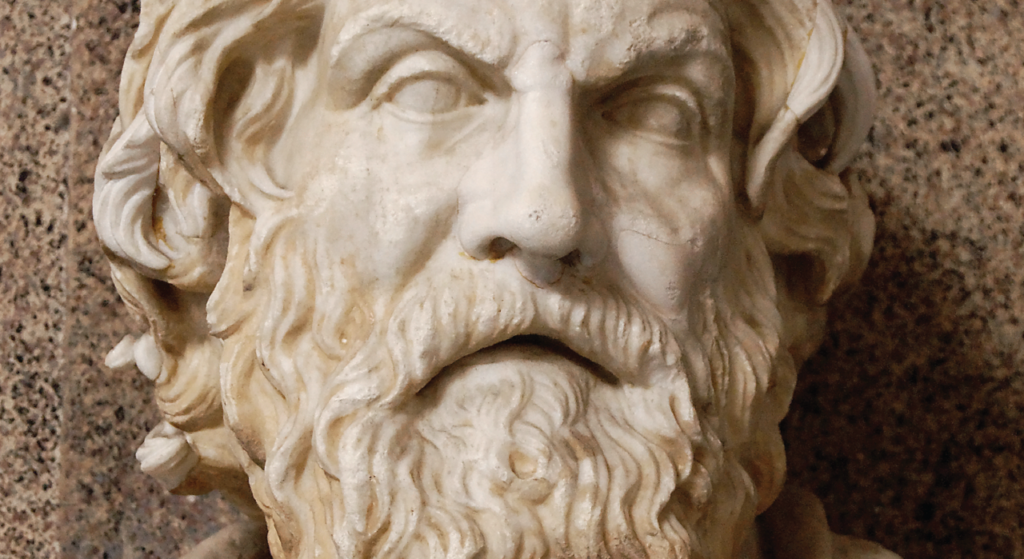
1) His Biography
Antisthenes, a prominent figure in ancient Greek philosophy, was born in Athens around 446 BCE. He was a pupil of Socrates, the renowned philosopher known for his questioning method, which aimed to stimulate critical thinking and self-examination. Antisthenes was deeply influenced by Socrates’ teachings, particularly his emphasis on virtue and the pursuit of wisdom. However, Antisthenes’ philosophical views would diverge from those of his mentor in significant ways.
Little is known about Antisthenes’ early life, but it is believed that he came from a wealthy family. Despite his privileged background, he chose to live a simple and ascetic lifestyle, rejecting material possessions and luxury. This commitment to a life of virtue and self-discipline would become central to his philosophical beliefs and teachings.
After the death of Socrates, Antisthenes continued to spread his mentor’s ideas, but he also developed his own philosophical system, which came to be known as Cynicism. Cynicism, derived from the Greek word “kynikos” meaning “dog-like,” reflected Antisthenes’ belief in living in accordance with nature and rejecting conventional norms and values. He advocated for a life of simplicity, self-sufficiency, and independence from societal conventions and desires.
Antisthenes’ philosophy placed great emphasis on virtue and moral excellence, considering them to be the highest goods. He believed that true happiness could only be attained through the cultivation of virtue and the rejection of worldly desires. This rejection of materialism and emphasis on virtue resonated with many people disillusioned with the corruption and excesses of Athenian society.
Despite his austere lifestyle, Antisthenes was highly respected in Athenian intellectual circles and attracted many followers, including the famous philosopher Diogenes of Sinope, who would become one of the most well-known Cynics. Antisthenes’ teachings also influenced other schools of thought, including Stoicism, which shared many similarities with Cynicism.
Throughout his life, Antisthenes remained committed to his philosophical principles, challenging conventional wisdom and advocating for a simpler, more virtuous way of life. His legacy as one of the founders of Cynicism and a pioneer of ethical philosophy continues to influence thinkers and philosophers to this day, reminding us of the importance of living in accordance with our true nature and values.
2) Ethical Intellectualism
Antisthenes was a proponent of Ethical Intellectualism, a philosophical concept that emphasises the inseparability of virtue and knowledge. For Antisthenes, true wisdom was not merely intellectual understanding but also practical application in one’s actions and choices. He believed that knowledge without virtue was meaningless, and that true wisdom could only be attained through the cultivation of moral excellence.
In Antisthenes’ view, the pursuit of knowledge was inherently tied to the pursuit of virtue. He argued that ethical behaviour stemmed from a deep understanding of what is morally right and just. This understanding required not only intellectual insight but also a commitment to living in accordance with one’s moral principles. For Antisthenes, ethical intellectualism was about aligning one’s thoughts, words, and actions with moral truth.
Central to Antisthenes’ ethical intellectualism was the idea of self-mastery and self-discipline. He believed that true wisdom involved overcoming one’s passions and desires, and exercising control over one’s impulses. This required constant self-examination and reflection, as well as a willingness to challenge one’s own beliefs and prejudices.
Antisthenes’ emphasis on ethical intellectualism can be seen in his teachings on the importance of living a virtuous life. He believed that virtue was the highest good and that happiness could only be attained through the pursuit of moral excellence. This emphasis on virtue as the cornerstone of a meaningful life was a central tenet of his philosophical system.
Furthermore, Antisthenes’ ethical intellectualism also influenced his views on the role of the philosopher in society. He believed that philosophers had a duty to lead by example, demonstrating through their own lives the principles they espoused. This meant living simply and modestly, rejecting the trappings of wealth and power, and prioritising moral integrity above all else.
3) His Contribution to Stoicism
Antisthenes made significant contributions to Stoicism, a philosophical school that emerged in Athens shortly after his lifetime. While not a Stoic himself, Antisthenes’ ideas and teachings laid the groundwork for many of the central concepts of Stoicism, influencing later Stoic philosophers such as Zeno of Citium.
One of the key contributions of Antisthenes to Stoicism was his emphasis on living in accordance with nature and rejecting conventional desires and attachments. This aligns closely with the Stoic belief in living in harmony with the natural order of the universe and accepting what is beyond one’s control. Antisthenes’ advocacy for a simple and virtuous life, free from the pursuit of wealth, fame, and pleasure, resonated with Stoic teachings on the importance of virtue as the highest good.
Furthermore, Antisthenes’ emphasis on self-mastery and self-discipline also influenced Stoic ethics. He believed that true wisdom involved overcoming one’s passions and desires, a notion that was central to Stoic teachings on the importance of cultivating inner tranquility and equanimity in the face of life’s challenges. Antisthenes’ focus on the importance of moral integrity and living in accordance with one’s principles also found echoes in Stoic ethics, which emphasised the cultivation of wisdom, courage, justice, and moderation.
Additionally, Antisthenes’ rejection of external goods and his emphasis on inner virtue resonated with Stoic teachings on the distinction between what is within our control (our thoughts, attitudes, and actions) and what is outside of our control (external circumstances). Stoicism encourages individuals to focus on cultivating virtues and developing a resilient mindset rather than becoming overly concerned with external events or possessions, a notion that can be traced back to Antisthenes’ teachings.
4) His Legacy
Antisthenes’ legacy in the history of philosophy is profound, leaving an indelible mark on subsequent generations of thinkers and influencing various philosophical schools. As one of the earliest figures of Western philosophy, his contributions reverberate through the ages, shaping the intellectual landscape of ancient Greece and beyond.
First and foremost, Antisthenes is remembered as a disciple of Socrates, embodying the spirit of Socratic inquiry and dialectical reasoning. His close association with Socrates not only helped to disseminate the ideas of his mentor but also laid the groundwork for his own philosophical innovations. Antisthenes’ commitment to truth-seeking and moral introspection mirrored Socrates’ ethos, forging a philosophical lineage that prized intellectual integrity and ethical inquiry.
Antisthenes’ most enduring legacy lies in the development of Cynicism, a philosophical movement that challenged societal norms and championed a life of simplicity and virtue. As the founder of Cynicism, Antisthenes inspired a generation of philosophers, including the iconic Diogenes of Sinope, whose radical rejection of material wealth and social conventions epitomised the Cynic ethos. The principles of Cynicism, rooted in Antisthenes’ disdain for luxury and his emphasis on self-sufficiency and moral integrity, continued to resonate throughout antiquity and beyond, influencing subsequent philosophical movements such as Stoicism.
Moreover, Antisthenes’ ideas found fertile ground in Stoic philosophy, particularly in the writings of Zeno of Citium, the founder of Stoicism. His emphasis on living in accordance with nature, cultivating inner virtue, and transcending worldly desires laid the groundwork for Stoic ethics, which sought to cultivate wisdom, courage, and resilience in the face of adversity. The Stoic conception of eudaimonia, or flourishing, owes much to Antisthenes’ vision of a life guided by moral excellence and inner tranquillity.
Beyond his direct influence on philosophical schools, Antisthenes’ legacy endures as a testament to the power of individual agency and moral conviction. His rejection of societal conventions and material wealth serves as a timeless reminder of the importance of living in accordance with one’s principles, even in the face of opposition or adversity. In an age marked by rapid social change and moral uncertainty, Antisthenes’ uncompromising commitment to virtue and truth remains as relevant as ever, inspiring subsequent generations to pursue lives of moral integrity and philosophical inquiry.