
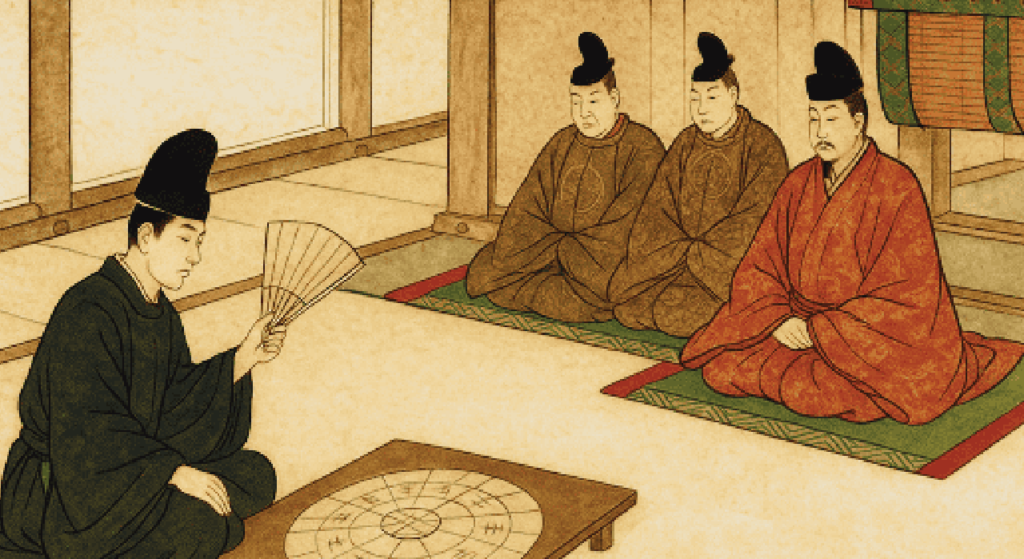
1) Their Main Principles
The Japanese school of astrologers known as the Onmyōji emerged from the system of Onmyōdō, a cosmological and divinatory tradition that synthesised Chinese Yin–Yang theory, the Five Phases (Wood, Fire, Earth, Metal, Water), and indigenous Japanese religious practices. At its core, the system rested on the dynamic interplay of opposites—yin and yang—whose balance governed both the natural world and human affairs. The Onmyōji believed that harmony between these forces ensured order, prosperity, and health, while imbalance led to calamity and disorder.
A second foundational principle was the Five Phases (Gogyō), understood not as static elements but as processes of transformation. Each phase generated and overcame others in cyclical patterns, shaping the rhythm of seasons, bodily health, political change, and spiritual conditions. Onmyōji applied these correspondences to diagnose misfortune, predict events, and prescribe ritual remedies, interpreting earthly events as reflections of cosmic processes.
Another key tenet was the concept of correspondence between heaven, earth, and humanity. The cosmos was seen as an interconnected system in which celestial movements directly influenced terrestrial phenomena. Astronomical observation therefore became inseparable from divination. Eclipses, planetary conjunctions, and unusual atmospheric events were read as signs requiring ritual intervention.
Ritual purification and apotropaic practice formed an essential dimension of their work. Onmyōji performed exorcisms, directional taboos (katatagae), and calendrical rites to avert malign spirits or inauspicious influences. Their authority lay not merely in prediction but in active mediation between spiritual and human realms.
Time reckoning was also central to their principles. By calculating auspicious and inauspicious days, they guided court ceremonies, travel plans, and political decisions. The calendar was not a neutral device but a sacred map aligning social order with cosmic rhythms.
Political legitimacy further intersected with their cosmology. By advising the imperial court, Onmyōji reinforced the notion that imperial authority was sanctioned by heavenly order. When cosmic balance was threatened, it was their role to restore harmony through ritual and calculation.
Onmyōji integrated esoteric knowledge systems, including Taoist practices and early Buddhist cosmology. This synthesis allowed their school to evolve into a uniquely Japanese discipline. Rather than remaining a purely imported doctrine, it became embedded in court life, folklore, and ritual governance, forming a distinctive intellectual tradition within Japan.
2) Their Contribution to Junishi
The Onmyōji played a crucial role in formalising and institutionalising the Junishi system—the twelve earthly branches—within Japanese calendrical and divinatory practice. Though originally imported from China, the twelve-branch system was refined and applied in Japan under their supervision, particularly within the imperial bureaucracy.
They integrated Junishi into official timekeeping. Each earthly branch corresponded not only to a year but also to months, days, and even two-hour segments. Through careful astronomical observation and calculation, Onmyōji ensured that these cyclical markers aligned with ritual obligations and court schedules.
The Onmyōji also expanded the symbolic associations of the twelve branches. Each branch was linked to animals, directions, elements, and yin–yang polarity. By combining these attributes, astrologers generated complex interpretive matrices used in horoscopy, geomancy, and ritual planning.
In addition, they harmonised Junishi with the Ten Heavenly Stems (Jikkan), producing the sixty-year sexagenary cycle. This system became fundamental in historical dating, astrological charts, and personality interpretation. Their computational expertise allowed for consistent application across generations.
Junishi also shaped directional taboos and travel advisories. Certain directions were deemed inauspicious on specific branch days. Onmyōji would recommend detours or temporary relocations to avoid spiritual pollution or disaster, thus embedding Junishi into daily life.
Beyond technical calculation, they embedded Junishi into mythic and symbolic narratives. The twelve animals became part of popular folklore and moral storytelling, linking cosmology with cultural imagination.
Through institutional continuity, especially during the Heian period, the Onmyōji ensured that Junishi became an enduring structure in Japanese temporal consciousness. Their scholarly codification preserved the system as both scientific calendar and spiritual compass.
3) What is Junishi?
Junishi refers to the twelve earthly branches, a cyclical system of temporal classification originating in ancient China and adopted into Japanese cosmology. Each branch corresponds to an animal sign: Rat, Ox, Tiger, Rabbit, Dragon, Snake, Horse, Goat, Monkey, Rooster, Dog, and Boar.
In its earliest function, Junishi was part of a broader calendrical apparatus used to measure time. The twelve branches marked years in a repeating cycle and were later applied to months, days, and hours. This structure created a rhythm that synchronised human activity with celestial motion.
Each branch carries symbolic attributes beyond its animal representation. They are associated with specific directions, elements from the Five Phases, and either yin or yang polarity. These correspondences create a layered interpretive system used in divination.
Junishi operates most fully when paired with the Ten Heavenly Stems, forming the sixty-year sexagenary cycle. This combined structure allows for more precise temporal designation and astrological profiling. In Japan, this became essential for historical dating and horoscope casting.
The animal imagery popularised Junishi in everyday culture. Birth years became associated with personality traits derived from the corresponding animal’s symbolic characteristics. Over time, this gave rise to a zodiac-like system familiar in contemporary Japan.
Junishi also functions spatially. Each branch aligns with a compass direction, influencing geomantic practices and architectural planning. Certain shrines and temples were positioned with these symbolic alignments in mind.
Today, Junishi remains visible in New Year traditions, calendars, and popular astrology. Though simplified in modern usage, its historical roots reveal a sophisticated cosmological framework that once structured governance, ritual, and personal destiny.
4) Main Contributors of the Onmyoji
Among the most celebrated figures of the Onmyōji tradition is Abe no Seimei. Serving the imperial court during the Heian period, he became legendary for his mastery of divination, exorcism, and celestial calculation. Historical records confirm his bureaucratic role, while folklore magnified him into a semi-mythical sorcerer capable of commanding spirits.
Seimei’s reputation endured partly because of later literary embellishments, including medieval tales and modern reinterpretations. His persona symbolised the intellectual and mystical authority of the Onmyōji, embodying both scholarly precision and supernatural charisma.
Another significant contributor was Kamo no Tadayuki, who helped institutionalise Onmyōdō within the imperial court. As an official astrologer, he systematised calendrical calculations and strengthened bureaucratic oversight of divination.
Tadayuki’s son, Kamo no Yasunori, further advanced the school’s intellectual foundations. He trained notable disciples and contributed to refining astronomical techniques, ensuring continuity in scholarly transmission.
These figures were not solitary mystics but state officials operating within the Bureau of Onmyō (Onmyōryō). Their expertise blended mathematics, astronomy, ritual practice, and esoteric learning, illustrating the multidisciplinary character of the school.
Collectively, these contributors transformed Onmyōdō from an imported cosmology into a structured Japanese institution. Their scholarship preserved classical Chinese knowledge while adapting it to local conditions and court politics.
Through both historical documentation and enduring legend, these Onmyōji shaped Japan’s spiritual and intellectual heritage. Their influence extended beyond court service into literature, theatre, and modern popular culture.
5) Its Legacy
The legacy of the Onmyōji lies first in their profound impact on Japanese calendrical consciousness. Even after the decline of official Onmyōdō institutions in the modern period, elements of their system survived in seasonal rituals, zodiac traditions, and cultural symbolism.
Their integration of cosmology into governance influenced political culture for centuries. The idea that celestial harmony validated earthly rule reinforced imperial ideology and shaped ceremonial life well into the medieval era.
In literature and folklore, the image of the Onmyōji evolved into a cultural archetype. Medieval tales portrayed them as masters of hidden knowledge, while later dramatic forms such as Noh and Kabuki drew upon their mystique.
Modern reinterpretations, particularly in manga, anime, and cinema, have revived interest in figures like Abe no Seimei. These portrayals often blend historical detail with fantasy, demonstrating the adaptability of the tradition’s imagery.
Architectural and spatial practices also bear traces of their geomantic principles. Certain shrine orientations and urban planning concepts reflect directional taboos and cosmological alignments inherited from Onmyōdō.
Scholarly study of Japanese intellectual history recognises the Onmyōji as mediators of continental knowledge. Their work illustrates how imported cosmology can be transformed into a distinctive national tradition.
The Onmyōji legacy persists not merely as superstition or folklore but as a testament to Japan’s historical synthesis of science, ritual, and governance. Their tradition reveals a worldview in which astronomy, spirituality, and political order formed a coherent and enduring whole.