Sheikh Riza Talabani
1) His Biography
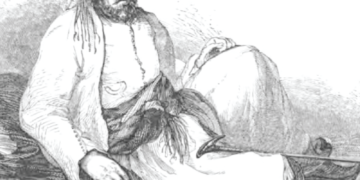
Sheikh Riza Talabani was a prominent Iraqi Kurdish poet and religious figure of the nineteenth century, widely recognised for his satirical verse and sharp social commentary. He was born in 1835 in the city of Kirkuk, a culturally diverse centre that played a significant role in shaping his linguistic and intellectual outlook. Kirkuk’s mixture of Kurdish, Arabic, Persian, and Turkish influences provided Talabani with a rich cultural environment that later informed both the language and themes of his poetry.
He was born into a respected religious family associated with Islamic scholarship and clerical authority. His father was a learned man, and from an early age Sheikh Riza received a traditional religious education. He studied Islamic jurisprudence, theology, Arabic grammar, and classical literature, acquiring the scholarly credentials expected of a cleric. This formal education earned him the honorific title of “Sheikh,” which he retained throughout his life.
Despite his religious training, Talabani developed a personality marked by intellectual independence and irreverence towards social hypocrisy. While he fulfilled clerical duties and was well versed in Islamic learning, he became increasingly critical of corrupt officials, pretentious scholars, and rigid moralists. This tension between religious authority and critical satire would become a defining feature of both his life and his poetry.
Sheikh Riza Talabani was fluent in several languages, including Kurdish, Arabic, Persian, and Turkish. His multilingual ability allowed him to engage with a wide range of literary traditions and audiences. Although he is best known for his Kurdish poetry, his familiarity with classical Arabic and Persian literature strongly influenced his stylistic range and rhetorical techniques.
His poetry circulated widely during his lifetime, often through oral performance and manuscript transmission rather than formal publication. Talabani’s sharp wit and fearless satire made him a well-known and sometimes controversial figure. He frequently mocked social elites, religious figures, and political authorities, which earned him both admiration and hostility in equal measure.
Throughout his life, Talabani experienced periods of tension with local rulers and influential figures, largely due to the biting nature of his verse. Nevertheless, his status as a religious scholar and his popularity among ordinary people provided him with a degree of protection. His poetry resonated particularly with common audiences who recognised their own frustrations reflected in his satirical attacks.
Sheikh Riza Talabani spent most of his life in Kirkuk, remaining closely connected to its social and cultural life. He continued writing poetry until his later years, maintaining a sharp critical voice even as political and social conditions changed. He died in 1910, leaving behind a substantial body of work that secured his reputation as one of the most distinctive Kurdish poets of his era.
Talabani’s biography reflects the complex intersection of religious authority, literary creativity, and social criticism in nineteenth-century Iraq. As both a cleric and a satirist, he occupied a unique position that allowed him to challenge power structures from within traditional frameworks. His life and work together illustrate how poetry could function as a form of cultural resistance and social commentary in a deeply hierarchical society.
2) Main Works
Diwan of Sheikh Riza Talabani
The principal body of Sheikh Riza Talabani’s poetry is preserved in his diwan, which includes satirical poems, lyrical verses, and occasional compositions. Written mainly in Kurdish, with some poems in Persian and Arabic, the diwan reflects his linguistic versatility and his command of classical poetic forms. It is particularly noted for its biting satire and fearless critique of social and religious hypocrisy.
Satirical Qasidas
Talabani’s satirical qasidas target corrupt officials, pretentious scholars, and self-righteous clerics. These poems use humour, irony, and exaggeration to expose moral decay and abuse of authority. While deeply critical, the satire is often playful, demonstrating Talabani’s skill in balancing sharp social criticism with poetic wit.
Poems of Social Commentary
A significant portion of his work focuses on everyday social realities, including injustice, poverty, and the misuse of power. These poems move beyond individual targets to critique broader social structures, presenting poetry as a voice for the marginalised. Their accessibility contributed to his popularity among ordinary people.
Religious and Moral Poems
Despite his satirical edge, Talabani also composed poems grounded in religious reflection and ethical instruction. These works draw on Islamic teachings to emphasise sincerity, humility, and moral responsibility. They reveal the depth of his religious learning and counterbalance the irreverence found in his satire.
Occasional and Personal Poems
Talabani wrote poems in response to personal experiences, social gatherings, and specific events. These occasional pieces often blend humour with personal reflection, offering insight into his character and daily life. They demonstrate his ability to adapt poetic form to a wide range of contexts.
Humorous Verse and Lampoons
His humorous poems and lampoons are among his most memorable works. Using colloquial language and vivid imagery, Talabani crafted verses that were easily remembered and recited. These works helped establish poetry as a form of popular entertainment as well as social critique.
Verse Correspondence
Some of Talabani’s poems function as exchanges with contemporaries, including scholars and poets. These verse letters showcase poetry as a medium of intellectual dialogue and playful rivalry, further highlighting his engagement with the literary culture of his time.
3) Main Themes
Satire and Social Criticism
Satire is the most defining theme in Sheikh Riza Talabani’s poetry. He used sharp wit and irony to expose hypocrisy, corruption, and moral pretence among religious figures, bureaucrats, and social elites. His satirical voice was fearless, often naming or clearly alluding to those in power, which made his poetry both controversial and widely admired.
Beyond ridicule, Talabani’s satire functioned as a moral instrument. By mocking false piety and abuse of authority, he aimed to restore ethical integrity within society. Humour became a tool of resistance, allowing him to criticise entrenched power structures while remaining accessible to ordinary readers and listeners.
Hypocrisy in Religious and Social Life
Talabani frequently targeted individuals who outwardly displayed religiosity while privately engaging in corruption or injustice. Drawing on his deep knowledge of Islamic teachings, he highlighted the gap between genuine faith and performative piety. This theme reflects his frustration with the misuse of religion for personal gain.
His critique was not anti-religious but reformist in spirit. By invoking religious ideals to condemn hypocrisy, Talabani positioned himself as a moral insider rather than an external critic, strengthening the ethical authority of his poetry.
Justice and Abuse of Power
Concerns about injustice and tyranny recur throughout Talabani’s work. He condemned oppressive rulers, dishonest judges, and exploitative officials, often portraying them as morally bankrupt and socially destructive. These poems reflect the lived realities of nineteenth-century Iraqi society under uneven governance.
Through poetic exaggeration and symbolic imagery, Talabani transformed local grievances into universal critiques of power. His work suggests that poetry can serve as a public conscience, holding authority accountable when formal mechanisms fail.
Humour and Mockery
Humour is central to Talabani’s poetic method. Even in his harshest critiques, he employed playful language, absurd imagery, and comic exaggeration. This humour made his poetry memorable and widely circulated, particularly in oral contexts.
Mockery also functioned as a levelling force, stripping powerful figures of their aura of authority. By laughing at those who claimed superiority, Talabani reaffirmed the dignity and intelligence of ordinary people.
Moral Integrity and Sincerity
Despite his irreverent tone, Talabani consistently upheld ideals of sincerity, honesty, and moral responsibility. He contrasted these virtues with the corruption he observed, presenting integrity as the true measure of religious and social worth.
These moral concerns anchor his satire in ethical seriousness. Rather than mere mockery, his poetry seeks to provoke reflection and reform, aligning humour with principled critique.
Everyday Life and Common Experience
Talabani frequently drew material from everyday social interactions, local customs, and familiar personalities. This grounding in common experience gave his poetry immediacy and relatability, strengthening its impact among diverse audiences.
By focusing on the ordinary, he elevated everyday struggles into subjects worthy of poetic attention. This approach reinforced poetry’s role as a living, socially embedded art rather than a purely elite literary pursuit.
4) Talabani as a Poet
Sheikh Riza Talabani occupies a distinctive place in Kurdish and Iraqi literary history as a poet who combined religious authority with fearless satire. His poetic identity is shaped by this dual position, allowing him to criticise social and moral failings from within the very structures he examined. This combination gave his voice both credibility and sharpness, setting him apart from many of his contemporaries.
As a poet, Talabani demonstrated exceptional command of language and tone. He moved effortlessly between elevated classical diction and colloquial expression, depending on the demands of the subject. This flexibility enabled him to reach both learned audiences and ordinary listeners, ensuring that his poetry circulated widely across social boundaries.
Satire was Talabani’s primary poetic mode, but it was underpinned by serious moral intent. His humour was not casual or purely entertaining; it functioned as a critical instrument aimed at exposing falsehood, arrogance, and injustice. By exaggerating flaws and contradictions, he revealed deeper social truths that might otherwise have remained unspoken.
Talabani’s religious education deeply informed his poetry. His familiarity with Islamic texts, legal discourse, and ethical traditions allowed him to critique religious hypocrisy with precision and authority. Rather than rejecting religion, he invoked its principles to condemn those who distorted it for personal or political advantage.
Orality played a significant role in Talabani’s poetic practice. Many of his poems were composed with performance in mind, using rhythmic clarity and memorable phrasing. This oral dimension contributed to the popularity of his verse and helped embed his poetry within communal memory rather than confining it to written manuscripts.
His fearless attitude towards power distinguished him as a poet of resistance. Talabani did not hesitate to satirise governors, judges, and influential clerics, despite the personal risks involved. This courage enhanced his reputation as a poet who spoke truth to power, reinforcing poetry’s role as a form of social accountability.
Talabani’s style is marked by directness and clarity rather than ornate complexity. While he was well versed in classical aesthetics, he avoided excessive embellishment, favouring sharp imagery and pointed expression. This stylistic choice amplified the impact of his satire and made his critiques unmistakable.
Sheikh Riza Talabani stands as a poet whose work bridged tradition and dissent. His poetry demonstrates how classical forms could be mobilised for bold social critique, combining wit, moral seriousness, and cultural rootedness. Through this synthesis, he secured his place as one of the most compelling poetic voices of nineteenth-century Iraq.
5) His Legacy
Sheikh Riza Talabani’s legacy is firmly established in the literary and cultural history of Iraq and Kurdistan as that of a poet who transformed satire into a powerful tool of social critique. He is remembered not merely for his technical skill but for his courage in confronting hypocrisy, corruption, and abuse of power through poetry. His work demonstrated that verse could function as a moral force within society, challenging authority while remaining rooted in cultural tradition.
One of Talabani’s most enduring contributions lies in his role in popularising Kurdish poetry as a medium of public expression. By employing accessible language, humour, and themes drawn from everyday life, he ensured that poetry reached beyond elite literary circles. This helped strengthen the bond between poetic expression and communal experience, reinforcing poetry’s relevance in social and political discourse.
His legacy is also significant within the tradition of satirical literature. Talabani showed that satire need not be superficial or purely comedic; instead, it could serve as a disciplined form of ethical critique. Later poets and writers drew inspiration from his example, adopting satire as a means of questioning authority and exposing moral contradictions within society.
As a religious scholar who openly criticised religious hypocrisy, Talabani occupies a unique position in intellectual history. His work challenged the assumption that clerical authority required silence or conformity, illustrating instead that genuine faith could coexist with critical inquiry. This aspect of his legacy continues to resonate in discussions about religion, ethics, and freedom of expression.
Talabani’s influence extended beyond literature into cultural memory. His poems were frequently recited, quoted, and adapted in oral traditions, ensuring their survival across generations. This oral transmission preserved not only his verses but also his reputation as a fearless and witty commentator on social life.
In academic contexts, Talabani is studied as a key figure in nineteenth-century Kurdish and Iraqi poetry. Scholars examine his work for its linguistic richness, its engagement with classical forms, and its innovative use of satire. His poetry provides valuable insight into the social tensions, moral concerns, and power structures of his time.
Culturally, Talabani represents a model of intellectual independence. His refusal to flatter authority or conform to social expectations has made him a symbol of resistance and integrity. This image has contributed to his lasting appeal, particularly among readers who value literature as a means of ethical engagement.
Sheikh Riza Talabani’s legacy lies in his successful fusion of tradition, humour, and moral seriousness. Through his fearless satire and deep cultural knowledge, he expanded the possibilities of poetic expression in his society. His work continues to be read not only as literature but as a testament to poetry’s enduring capacity to challenge injustice and affirm human dignity.