
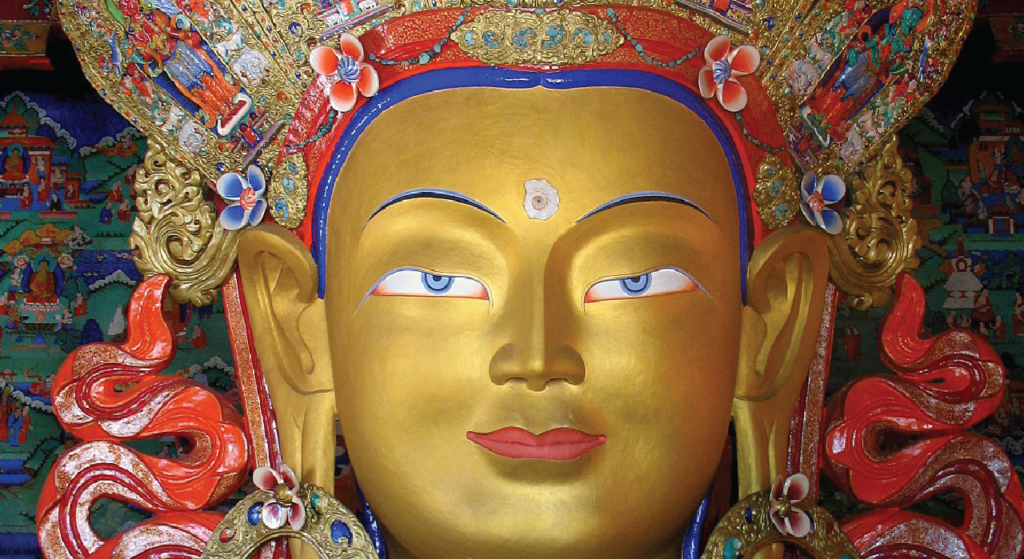
1) His Biography
Maitreya-natha, a significant figure in Buddhist thought and tradition, is revered as the future Buddha in many Buddhist schools. His biography, though shrouded in myth and legend, reflects profound spiritual insights and teachings. Born in the celestial realm of Tushita, Maitreya-natha is believed to have made a vow to return to the human realm as the next Buddha, following the teachings and path laid down by Gautama Buddha.
According to Buddhist scriptures, Maitreya-natha’s birth as Siddhartha Gautama’s successor was prophesied by Gautama himself. The future Buddha’s life story unfolds with tales of his altruism, compassion, and unwavering commitment to enlightenment. Legends depict him as embodying the virtues of patience, kindness, and wisdom, traits essential for Buddhahood.
Maitreya-natha’s early life in Tushita is often described as one of profound spiritual cultivation and learning under the guidance of celestial beings and past Buddhas. His resolve to alleviate suffering and guide sentient beings towards liberation remains central to his character and purpose.
The narrative of Maitreya-natha’s biography often highlights his eventual descent from the celestial realm to be reborn as a human being. This transition symbolizes his compassionate engagement with the human condition and his readiness to fulfill his Bodhisattva vow.
Throughout his earthly existence, Maitreya-natha’s teachings and actions exemplify the Bodhisattva path. He is depicted as wandering among ordinary people, offering teachings, solace, and practical guidance on the path to awakening. Stories of his encounters with disciples, debates with scholars, and acts of compassion abound in Buddhist literature.
Maitreya-natha’s biography underscores his deep empathy and understanding of human suffering. His teachings on loving-kindness, compassion, and the cultivation of wisdom resonate across Buddhist traditions, inspiring countless practitioners to aspire to Buddhahood.
In many Buddhist accounts, Maitreya-natha’s life culminates in his eventual attainment of enlightenment and the fulfillment of his Bodhisattva vow. His awakening symbolizes the triumph of wisdom and compassion over ignorance and suffering, offering hope and guidance to all beings on the path to liberation.
2) Main Works
Mahayana-sutralankara (Ornament of the Mahayana Sutras):
This seminal work by Maitreya-natha is a comprehensive treatise on Mahayana Buddhist philosophy and practice. The text systematically expounds upon key Mahayana concepts such as emptiness (shunyata), compassion (karuna), and the Bodhisattva path. “Mahayana-sutralankara” serves as a foundational text for understanding the philosophical underpinnings of Mahayana Buddhism and has been widely studied and commented upon by scholars throughout history.
Abhisamayalamkara (Ornament of Clear Realization):
Considered one of Maitreya-natha’s most profound works, the “Abhisamayalamkara” elaborates on the path to enlightenment as delineated in the Mahayana tradition. It systematically presents the stages of the Bodhisattva path, the perfections (paramitas), and the qualities of a fully awakened being. This text is highly regarded for its clarity and depth of insight into the nature of reality and the practices leading to liberation.
Madhyantavibhaga (Distinguishing the Middle from the Extremes):
Written in the form of a commentary on the Prajnaparamita sutras, the “Madhyantavibhaga” elucidates the concept of emptiness (shunyata) and its relationship to the Middle Way philosophy. Maitreya-natha’s commentary provides a systematic analysis of the nature of reality, emphasizing the non-dualistic understanding of emptiness and the cessation of suffering.
Distinguishing Phenomena and Pure Being (also known as “Dharmadharmatavibhaga”):
This text delves into the fundamental distinction between conventional phenomena and ultimate reality. Maitreya-natha elucidates the nature of phenomena and their relationship to the ultimate truth, emphasizing the interdependence and emptiness of all phenomena. “Distinguishing Phenomena and Pure Being” is celebrated for its lucid exposition of key Mahayana philosophical principles.
Ratnagotravibhaga (Treatise on the Mahayana Path to Buddhahood):
Also known as the “Uttaratantra Shastra,” this text explores the nature of the Buddha-nature (tathagatagarbha) inherent in all sentient beings. Maitreya-natha expounds upon the innate potential for enlightenment within every being and provides teachings on how to actualize this potential through the cultivation of wisdom and compassion. The “Ratnagotravibhaga” has been influential in Mahayana thought, particularly in the Yogacara and Tathagatagarbha traditions.
3) Yogachara School
The Yogachara School, also known as the Yogācāra, Vijñanavada, or Consciousness-Only School, is one of the major philosophical schools within Mahayana Buddhism. Developed in India during the fourth and fifth centuries CE, the Yogachara School profoundly influenced Buddhist thought, especially in East Asian countries like China and Japan. This school is renowned for its sophisticated analyses of consciousness, perception, and the nature of reality.
At the heart of Yogachara philosophy lies the concept of vijñapti-matra, or “mind-only.” According to Yogachara teachings, reality is ultimately a construct of mind or consciousness. Phenomena are perceived and experienced through the lens of individual and collective consciousness, and they lack inherent existence apart from these mental constructions.
One of the key figures associated with the development of Yogachara thought is the Indian philosopher Vasubandhu, whose works, such as the “Twenty Verses on Consciousness Only” (Vijñaptimatratasiddhi Shastra), played a pivotal role in articulating the school’s doctrines. Vasubandhu, along with his half-brother Asanga, contributed significantly to the elaboration and systematization of Yogachara philosophy.
The Yogachara School proposes various models to explain the workings of consciousness and perception. One notable model is the eight consciousnesses, which categorize the different layers or aspects of consciousness. These include the six sense-consciousnesses (associated with the senses) and the seventh consciousness (manas), which processes sensory data and generates mental formations. The eighth consciousness (alaya-vijnana), often referred to as the “storehouse consciousness,” stores karmic imprints and seeds of past actions, conditioning future experiences.
Yogachara teachings emphasise the impermanent and interdependent nature of phenomena, highlighting the role of ignorance (avidya) in perpetuating the cycle of suffering (samsara). By understanding the nature of consciousness and the illusory nature of perceived reality, practitioners can cultivate wisdom (prajna) and transcend the limitations of dualistic thinking.
Meditative practices play a central role in Yogachara Buddhism, as they are seen as a means to directly experience the nature of mind and reality. Through techniques such as mindfulness, introspection, and insight meditation, practitioners aim to penetrate the layers of conceptual conditioning and awaken to the true nature of existence.
Yogachara philosophy has had a profound impact on various strands of Mahayana Buddhism, including Zen in Japan and Chan in China. Its emphasis on meditative insight, the non-dual nature of reality, and the transformative power of consciousness continues to inspire Buddhist practitioners and scholars worldwide.
4) Maitreya-natha, Father of Yogachara
Maitreya-natha, often regarded as the “Father of Yogachara,” made significant contributions to the development and elaboration of Yogachara philosophy within Mahayana Buddhism. His works, particularly those related to the nature of mind and consciousness, have had a profound influence on the evolution of Yogachara thought.
One of Maitreya-natha’s key contributions to the Yogachara School is his elucidation of the concept of tathagatagarbha, or the Buddha-nature. In his treatise known as the “Ratnagotravibhaga” (Treatise on the Mahayana Path to Buddhahood), also referred to as the “Uttaratantra Shastra,” Maitreya-natha expounds upon the inherent potential for enlightenment within all sentient beings. He posits that every individual possesses the seed or essence of Buddhahood, which can be nurtured and actualized through spiritual practice and realization.
Furthermore, Maitreya-natha’s teachings in the “Madhyantavibhaga” (Distinguishing the Middle from the Extremes) and other works shed light on the nature of consciousness and the mind-body relationship. He explores the interplay between subject and object, emphasizing the subjective nature of perception and the construction of reality through mental processes. Maitreya-natha’s insights into consciousness and perception laid the groundwork for later Yogachara scholars to develop sophisticated models of mind and cognition.
Moreover, Maitreya-natha’s works address the issue of suffering and the path to liberation. He outlines the Bodhisattva ideal and the practices conducive to awakening, stressing the cultivation of compassion, wisdom, and ethical conduct. His teachings on the Bodhisattva path resonate deeply with Yogachara principles, which prioritize the alleviation of suffering and the realization of ultimate truth for the benefit of all beings.
In addition to his philosophical contributions, Maitreya-natha’s role as a visionary and spiritual guide inspired generations of Buddhist practitioners to engage in contemplative inquiry and inner transformation. His emphasis on the innate potential for enlightenment within each individual reflects a compassionate worldview that transcends sectarian boundaries and speaks to the universal aspirations of humanity.
5) Western Scholars on Maitreya-natha
Western scholars have long been intrigued by the figure of Maitreya-natha and his contributions to Buddhist thought and philosophy. Through scholarly research, analysis, and interpretation, Western academics have offered valuable insights into Maitreya-natha’s significance within the broader context of Buddhist studies.
One notable aspect of Western scholarship on Maitreya-natha is the examination of his philosophical works and their impact on Buddhist thought. Scholars such as Paul Williams, Jan Nattier, and David Seyfort Ruegg have conducted extensive studies on Maitreya-natha’s texts, elucidating their doctrinal content, historical context, and transmission within Buddhist traditions. Their analyses have shed light on the complexities of Maitreya-natha’s thought and its relevance to contemporary philosophical discourse.
Moreover, Western scholars have explored Maitreya-natha’s role in the development of Mahayana Buddhism and the transmission of Buddhist teachings across different cultural and geographical contexts. John Powers, for instance, has examined the historical evolution of Maitreya-natha’s cult and its manifestations in various Buddhist traditions, highlighting the diverse ways in which Maitreya-natha has been venerated and interpreted by different communities.
In addition to textual analysis, Western scholars have engaged with Maitreya-natha’s biography and mythological narratives, critically examining the sources and motifs associated with his legendary status as the future Buddha. Scholars such as Donald S. Lopez Jr. and Rupert Gethin have explored the cultural, social, and religious dimensions of Maitreya-natha’s mythos, highlighting the symbolic significance of his messianic role within Buddhist cosmology.
Furthermore, Western scholars have investigated Maitreya-natha’s influence beyond the boundaries of traditional Buddhist studies, exploring intersections with other philosophical and religious traditions. Roger R. Jackson, for instance, has examined the parallels between Maitreya-natha’s teachings and contemporary Western philosophical thought, drawing connections between Yogachara philosophy and phenomenology, existentialism, and postmodernism.
6) His Legacy
Maitreya-natha’s legacy within Buddhist thought and practice is profound and far-reaching, transcending geographical and temporal boundaries. As the future Buddha and the embodiment of compassion and wisdom, Maitreya-natha continues to inspire millions of practitioners across the globe, leaving an indelible mark on the fabric of Mahayana Buddhism.
One of the most enduring aspects of Maitreya-natha’s legacy is his seminal contributions to Buddhist philosophy, particularly within the Yogachara and Madhyamaka traditions. His works, including the “Mahayana-sutralankara” and the “Abhisamayalamkara,” have served as foundational texts for generations of scholars and practitioners, elucidating key Mahayana concepts such as emptiness, compassion, and the Bodhisattva path.
Furthermore, Maitreya-natha’s teachings on the nature of reality and the path to enlightenment continue to inform contemporary Buddhist scholarship and spiritual practice. His emphasis on the cultivation of wisdom, compassion, and ethical conduct resonates deeply with the core principles of Mahayana Buddhism, inspiring individuals to embark on the Bodhisattva path and work tirelessly for the welfare of all sentient beings.
Maitreya-natha’s legacy extends beyond the realm of philosophy and doctrine to encompass his role as a spiritual guide and beacon of hope for countless devotees. As the future Buddha, Maitreya-natha symbolizes the promise of a future age of enlightenment and liberation, instilling optimism and perseverance in the hearts of believers as they navigate the challenges of worldly existence.
Moreover, Maitreya-natha’s mythological and iconographic representations have had a profound impact on Buddhist art, literature, and iconography. Depictions of Maitreya-natha as a bodhisattva adorned with royal regalia, holding the attributes of royalty and compassion, adorn temples, stupas, and sacred sites throughout the Buddhist world, serving as objects of veneration and inspiration for devotees.