
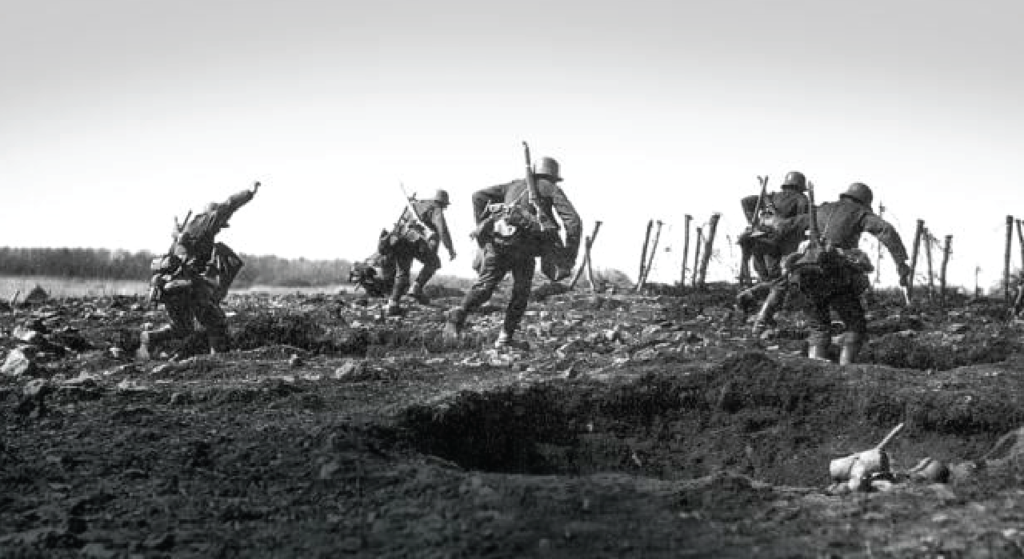
1) What is Maneuver Warfare?
Maneuver warfare is a military philosophy that seeks to defeat an adversary not through sheer destruction of forces, but by shattering their cohesion, will, and ability to function effectively. Rather than focusing on attrition—where victory is achieved by gradually wearing down the enemy—maneuver warfare emphasises speed, flexibility, and psychological disruption. Its central premise is that war is fundamentally a contest of opposing wills, and that dislocating the enemy mentally and organisationally can be more decisive than physically annihilating them.
At its core, maneuver warfare prioritises the exploitation of weakness over the confrontation of strength. Commanders aim to identify vulnerabilities in the enemy’s disposition—whether physical, logistical, or psychological—and strike at those points in a way that produces disproportionate effects. This often involves bypassing heavily defended positions and instead targeting command structures, supply lines, or critical nodes that hold the enemy system together. The objective is to create cascading failures rather than incremental gains.
Speed plays a crucial role in this approach, not merely as physical rapidity but as tempo—the ability to act faster than the enemy can react. By maintaining a higher operational tempo, forces employing maneuver warfare can generate confusion and paralysis within the opponent’s decision-making processes. The enemy becomes reactive, constantly attempting to catch up, which erodes their capacity to coordinate coherent responses. In this sense, time itself becomes a weapon.
Another defining feature of maneuver warfare is decentralised decision-making. Subordinate commanders are granted significant autonomy to exploit fleeting opportunities as they arise. This requires a high level of trust, training, and shared understanding of intent. Rather than rigidly following pre-set plans, units adapt dynamically to changing circumstances, guided by overarching objectives rather than detailed instructions. This flexibility allows the force to remain agile and responsive in unpredictable environments.
Maneuver warfare also places strong emphasis on initiative. Every level of command is encouraged to think creatively and act decisively without waiting for orders when circumstances demand it. This cultural aspect is critical, as hesitation or over-reliance on hierarchy can negate the advantages of speed and adaptability. Initiative ensures that opportunities are seized immediately, preventing the enemy from regaining equilibrium.
Psychological impact is another key dimension. By striking unexpectedly and exploiting weaknesses, maneuver warfare aims to induce shock, confusion, and a sense of helplessness within the enemy. When command structures break down and units lose confidence in their leadership or situation, resistance can collapse rapidly. Thus, the destruction of the enemy’s will becomes as important—if not more so—than the destruction of their material capabilities.
Importantly, maneuver warfare is not synonymous with movement alone. While mobility is often a tool, the essence lies in creating advantage through positioning and timing rather than simply advancing quickly. Even static forces can apply maneuver principles by shifting focus, exploiting information, or applying pressure in unexpected ways. The emphasis is always on outthinking rather than outmuscling the opponent.
Maneuver warfare represents a holistic approach to conflict that integrates physical, mental, and organisational dimensions. It demands a deep understanding of both one’s own capabilities and the enemy’s vulnerabilities. When executed effectively, it allows a force to achieve decisive results with economy of effort, turning the chaos of war into an opportunity for calculated and strategic disruption.
2) Surfaces and Gaps
A central concept within maneuver warfare is the distinction between “surfaces” and “gaps,” which provides a practical framework for identifying where and how to apply force. Surfaces refer to areas of strength in the enemy’s disposition—well-defended positions, concentrated firepower, or highly alert units that are prepared to resist. Gaps, by contrast, are areas of weakness: poorly defended sectors, seams between units, logistical vulnerabilities, or moments of inattention. The art of maneuver lies in avoiding surfaces while penetrating gaps.
This distinction fundamentally shifts how a commander views the battlefield. Instead of seeing a continuous front line to be broken through uniformly, the battlefield is perceived as an uneven landscape of strengths and weaknesses. This mental model encourages selective engagement rather than indiscriminate confrontation. Forces are guided not by the shortest path to the objective, but by the path of least resistance that leads to maximum disruption.
Identifying gaps is not always straightforward, as they may be fleeting or concealed. Gaps can exist not only in physical space but also in time and function. For example, a temporary lapse in communication, a delayed reinforcement, or a misalignment between adjacent units can create opportunities. Commanders must therefore develop a keen sense of observation and anticipation, often relying on incomplete information to make rapid judgements about where such vulnerabilities may lie.
Surfaces, although typically avoided, still play an important role in shaping operations. They can be fixed or contained to prevent the enemy from reallocating strength to threatened areas. By applying pressure on surfaces without committing fully to them, a force can distract or pin the enemy, effectively masking the true point of main effort. This indirect approach reinforces the element of surprise and contributes to the overall dislocation of the opponent.
The successful exploitation of gaps often leads to a cascading effect within the enemy system. Once a penetration is achieved, forces can move rapidly into the enemy’s rear areas, disrupting command, logistics, and cohesion. This creates confusion and forces the opponent to react under pressure, often leading to overextension or misallocation of resources. The initial gap thus becomes a gateway to broader systemic collapse.
Importantly, gaps are not static features; they are created as much as they are discovered. Through deception, feints, and shaping operations, a commander can induce the enemy to expose or even generate vulnerabilities. For instance, drawing attention to one sector may cause the enemy to shift forces, inadvertently weakening another. In this way, maneuver warfare involves actively manipulating the battlefield to produce exploitable conditions.
The concept also underscores the importance of dispersion and flexibility within one’s own forces. By avoiding rigid formations and maintaining the ability to shift quickly, units can exploit gaps as they emerge. This requires not only mobility but also effective communication and a shared understanding of intent, ensuring that opportunities are recognised and acted upon at all levels of command.
The surfaces-and-gaps framework encapsulates the essence of maneuver warfare’s indirect approach. It prioritises efficiency over brute force, encouraging commanders to think in terms of leverage rather than mass. By consistently seeking out and exploiting weaknesses while sidestepping strengths, a force can achieve disproportionate effects, turning limited resources into decisive outcomes.
3) Reconnaissance-Pull
Reconnaissance-pull is a defining operational method within maneuver warfare, in which the movement and commitment of forces are guided by reconnaissance rather than predetermined plans. Instead of commanders dictating a fixed axis of advance and forcing units to adhere to it, reconnaissance elements move forward first, probing the battlefield to discover where opportunities and resistance lie. The main body of forces is then “pulled” along the paths identified as most advantageous, ensuring that effort is directed towards exploitable conditions rather than imposed assumptions.
This approach represents a reversal of traditional “command-push” methods, where units are driven forward according to a rigid scheme regardless of emerging realities. In reconnaissance-pull, information takes precedence over preconception. Plans become adaptive frameworks rather than strict blueprints, allowing the force to respond dynamically to the evolving situation. This reduces the likelihood of costly engagements with enemy strengths and increases the chances of encountering and exploiting weaknesses.
The effectiveness of reconnaissance-pull depends heavily on the quality and initiative of reconnaissance units. These elements must operate with a high degree of autonomy, making rapid judgements about terrain, enemy dispositions, and potential avenues of advance. Their role is not merely to observe but to interpret and recommend, effectively shaping the direction of the entire operation. This places significant demands on training, judgement, and communication.
Speed and tempo are critical in this process. Information gathered by reconnaissance units must be transmitted quickly and acted upon without delay. If the main force is too slow to respond, gaps may close, and opportunities may vanish. Conversely, when executed effectively, reconnaissance-pull allows a force to maintain momentum while continuously refining its direction, creating a fluid and responsive operational rhythm that is difficult for the enemy to anticipate.
Another important aspect is the minimisation of friction. By allowing the battlefield itself to dictate movement, reconnaissance-pull reduces the need for forces to overcome heavily defended obstacles. Units are less likely to become bogged down in attritional engagements, preserving combat power and maintaining operational coherence. This contributes to the broader aim of maneuver warfare: achieving decisive effects with minimal expenditure of resources.
Reconnaissance-pull also enhances deception and unpredictability. Because the main effort emerges organically rather than being fixed in advance, it becomes harder for the enemy to identify and counter it. The shifting focus of movement can create ambiguity, forcing the opponent to spread their forces thinly or react too slowly. This uncertainty compounds the psychological pressure already inherent in maneuver-based operations.
The method requires a robust command philosophy centred on intent rather than control. Higher commanders must articulate clear objectives and desired outcomes, but refrain from micromanaging execution. Subordinate units, particularly reconnaissance elements, must feel empowered to act on their findings and adjust plans accordingly. This decentralisation is essential for maintaining the flexibility that reconnaissance-pull demands.
Reconnaissance-pull aligns action with reality. It ensures that operations are shaped by the actual conditions of the battlefield rather than by outdated or incomplete expectations. By allowing opportunity to guide movement, it maximises the efficiency and effectiveness of the force, turning uncertainty into an advantage rather than a liability.
4) The OODA Loop
The concept of the OODA Loop—Observe, Orient, Decide, Act—originates from the work of John Boyd, and serves as a foundational idea in maneuver warfare. It describes the continuous cycle through which individuals and organisations process information and respond to their environment. In a military context, success often depends on cycling through this loop more rapidly and effectively than the opponent, thereby gaining a decisive cognitive and operational advantage.
The first stage, observation, involves gathering data about the environment, including enemy movements, terrain, and unfolding events. However, observation alone is insufficient without accurate interpretation. This leads to the second stage, orientation, which is widely regarded as the most critical part of the loop. Orientation encompasses the mental models, cultural factors, training, and prior experiences that shape how information is understood. Two forces may observe the same situation but interpret it very differently, leading to divergent decisions.
Decision follows orientation and represents the selection of a course of action based on one’s understanding of the situation. In maneuver warfare, decision-making must be both rapid and flexible, allowing commanders and units to respond to changing circumstances without hesitation. This is closely tied to decentralised command structures, where subordinate leaders are empowered to make decisions independently within the framework of the overall intent.
The final stage, action, is the execution of the chosen decision. Importantly, action is not the end of the process but feeds back into the loop, generating new observations and restarting the cycle. This continuous feedback mechanism allows forces to adapt in real time, refining their actions as new information becomes available. The loop is therefore dynamic, not linear, and its effectiveness depends on the seamless integration of all four stages.
In maneuver warfare, the goal is not merely to operate efficiently within one’s own OODA Loop, but to disrupt the enemy’s. By acting unpredictably and at a high tempo, a force can create confusion and uncertainty within the opponent’s decision-making cycle. The enemy becomes disoriented, unable to interpret events accurately or respond in a timely manner. This leads to hesitation, errors, and ultimately a breakdown in cohesion.
Speed alone, however, is not sufficient. Cycling through the loop quickly but inaccurately can lead to poor decisions and self-inflicted problems. What matters is the combination of speed and accuracy, particularly in the orientation phase. A well-trained and cohesive force with shared understanding can orient more effectively, enabling faster and more reliable decision-making. This highlights the importance of doctrine, training, and organisational culture in supporting maneuver warfare.
The OODA Loop also underscores the importance of initiative at all levels. Since the loop operates continuously and often under conditions of uncertainty, individuals must be willing to act without waiting for perfect information or explicit orders. This decentralised approach ensures that the organisation as a whole can maintain momentum, even when communication is imperfect or disrupted.
The OODA Loop provides a framework for understanding how advantage is generated in conflict. It shifts the focus from static measures of strength to dynamic processes of perception and action. By accelerating one’s own decision cycle while degrading that of the enemy, a force can achieve disproportionate effects, turning the tempo of operations into a decisive weapon.
5) Main Effort and Supporting Effort
Within maneuver warfare, the concepts of main effort and supporting effort provide a means of focusing combat power without resorting to rigid control. The main effort refers to the unit, axis, or activity designated as the decisive point of an operation—the place where success will have the greatest impact on the overall mission. Supporting efforts, by contrast, are those elements that enable, protect, or amplify the effectiveness of the main effort without becoming decisive in their own right.
The designation of a main effort is not merely a matter of resource allocation but of intent.
Commanders communicate clearly which element holds priority, ensuring that all subordinate units understand where the decisive outcome is expected to occur. This shared understanding allows forces to align their actions even in fluid and uncertain conditions, reducing the need for constant direction and enabling initiative at lower levels.
Supporting efforts play a crucial but often understated role. They may fix enemy forces in place, create diversions, secure flanks, provide logistical support, or suppress key threats. Although they are not the focal point, their contribution is essential in shaping the conditions that allow the main effort to succeed. Without effective support, the main effort risks becoming isolated or overwhelmed.
A key feature of this framework is its flexibility. The main effort can shift as the situation evolves, particularly in dynamic environments where opportunities emerge unexpectedly. Commanders must be prepared to reassign priorities rapidly, designating a new main effort when circumstances demand it. This adaptability ensures that the force remains aligned with the most promising avenue of success rather than persisting with an outdated plan.
The relationship between main and supporting efforts also reflects the broader philosophy of economy of force. Not every unit needs to engage decisively; indeed, spreading resources evenly can dilute effectiveness. By concentrating effort at a critical point while maintaining sufficient support elsewhere, a force can achieve disproportionate results. This selective concentration is a hallmark of maneuver warfare’s indirect approach.
Clarity of intent is vital for this system to function. Subordinate commanders must understand not only their own roles but also how those roles relate to the main effort. This requires concise and effective communication, often expressed through commander’s intent rather than detailed orders. When properly conveyed, this intent enables units to act independently while still contributing coherently to the overall objective.
There is also an inherent interplay between risk and opportunity. Supporting efforts may operate with fewer resources or under constraints to prioritise the main effort, which can expose them to greater risk. However, this calculated imbalance is necessary to generate decisive outcomes. The art lies in managing these risks without compromising the integrity of the operation as a whole.
Ultimately, the distinction between main and supporting efforts provides a structured yet flexible way to organise action in a complex environment. It allows commanders to focus energy where it matters most while maintaining the cohesion and support necessary for success. By aligning all elements towards a decisive point, maneuver warfare achieves unity of effort without sacrificing adaptability.
6) Combined Arms Breaching
Combined arms breaching represents a specialised application of maneuver warfare principles in situations where an enemy has established strong defensive positions. Unlike the broader preference for avoiding “surfaces,” breaching acknowledges that certain obstacles—such as minefields, fortifications, and entrenched forces—must be penetrated directly. The key distinction is that this is not done through isolated force, but through the coordinated integration of multiple combat arms to create a temporary and localised advantage.
At its core, combined arms breaching relies on the synchronisation of different capabilities—typically infantry, armour, engineers, and artillery—to overcome defensive systems that would be too resilient for any single element alone. Engineers may clear obstacles, artillery suppresses enemy positions, armour provides protection and firepower, and infantry secures the breach. The effectiveness lies not in the individual components, but in their precise timing and mutual support.
The breaching process is often described through a sequence of actions: suppress, obscure, secure, reduce, and assault. Suppression involves neutralising enemy fire to prevent effective resistance. Obscuration, often using smoke, limits the enemy’s ability to observe and target the breaching force. Securing isolates the breach site to prevent reinforcement or interference. Reduction refers to the physical clearing of obstacles, and assault is the final movement through the breach to seize the objective beyond.
Timing is critical in this process. Each element must act in coordination with the others, as delays or misalignment can expose vulnerabilities. For example, if suppression is lifted too early or reduction takes too long, the breaching force may become vulnerable to concentrated enemy fire. This requirement for precision places high demands on planning, communication, and rehearsals, even within a doctrine that otherwise values flexibility.
Despite its structured nature, combined arms breaching still aligns with maneuver warfare’s emphasis on exploiting opportunity. Breaches are typically conducted at points where the enemy is weakest or least prepared, often identified through reconnaissance and shaping operations. The aim is not to attack the strongest part of the defence, but to create and exploit a local gap that can be rapidly expanded into a broader breakthrough.
Another important aspect is momentum. Once a breach is achieved, forces must move quickly to exploit it before the enemy can reorganise. This transition from breaching to exploitation is critical; a successful breach that is not followed by rapid manoeuvre risks becoming a static engagement, negating the advantages gained. Maintaining tempo ensures that the enemy remains disoriented and unable to mount an effective response.
Combined arms breaching also illustrates the balance between deliberate planning and adaptive execution. While the sequence of actions is well understood, real-world conditions often require adjustments on the ground. Units must be prepared to modify their approach in response to unexpected resistance, terrain challenges, or equipment limitations, all while maintaining coordination with other elements.
Combined arms breaching demonstrates that maneuver warfare is not about avoiding difficulty altogether, but about overcoming it intelligently. When direct action against a strongpoint is unavoidable, success depends on integration, timing, and the creation of local superiority. By combining multiple capabilities into a unified effort, a force can penetrate even well-prepared defences and restore the conditions for manoeuvre to resume.