
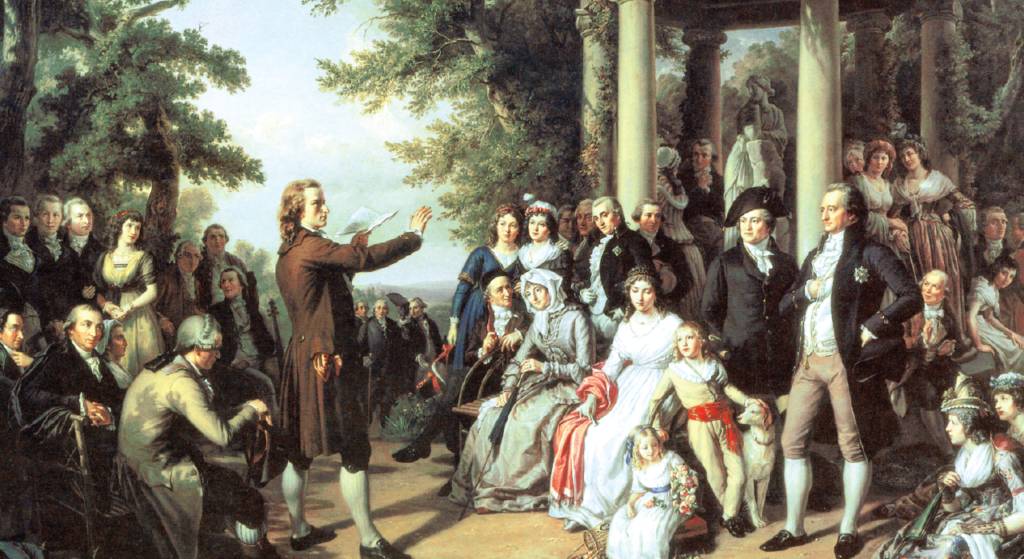
1) What is Weimar Classicism?
Weimar Classicism was a literary and cultural movement that flourished in the late eighteenth and early nineteenth centuries in the German duchy of Weimar. It is most closely associated with the collaboration between Johann Wolfgang von Goethe and Friedrich Schiller, whose partnership shaped its intellectual and aesthetic direction. The movement sought to harmonise reason and emotion, freedom and form, individuality and universal human values. Emerging after the turbulence of the Sturm und Drang period, Weimar Classicism represented a turn towards balance, restraint, and moral elevation.
Historically, the movement developed roughly between 1786, when Goethe travelled to Italy and encountered classical art firsthand, and Schiller’s death in 1805. The small court of Weimar became a centre of cultural activity under the patronage of enlightened rulers, particularly Duchess Anna Amalia and Duke Carl August. This relatively stable political environment enabled writers and thinkers to pursue ambitious artistic projects aimed at refining both individual character and society as a whole.
At its core, Weimar Classicism was deeply influenced by ancient Greek and Roman ideals. Classical antiquity was not imitated mechanically but treated as a model of aesthetic harmony and ethical clarity. Greek sculpture, drama, and philosophy embodied a vision of proportion and unity that German writers believed modern Europe could learn from. The aim was not nostalgic revival but cultural renewal grounded in universal principles.
Philosophically, the movement was shaped by Enlightenment thought, especially the ideas of Immanuel Kant concerning autonomy, morality, and aesthetic judgement. Weimar Classicists believed that art had a formative function: it could cultivate moral sensibility and refine the individual’s inner life. Literature was therefore not merely entertainment but an instrument of Bildung—self-cultivation directed towards ethical and intellectual maturity.
Unlike Romanticism, which would soon follow, Weimar Classicism did not celebrate unrestrained emotion or subjective intensity. Instead, it emphasised equilibrium. Passion was to be disciplined by reason, and individuality was to be shaped into a coherent moral character. The movement sought synthesis rather than conflict, aspiring to integrate the sensual and the rational into a unified human ideal.
The aesthetic principles of Weimar Classicism were expressed across genres, including poetry, drama, and prose. Dramatic works often revisited classical themes or historical subjects to explore universal moral dilemmas. The language was typically measured and elevated, reflecting the aspiration towards clarity and dignity. Artistic form was regarded as essential to conveying ethical substance.
Weimar Classicism represented an effort to articulate a vision of humanity at its highest potential. It proposed that through education, artistic engagement, and moral reflection, individuals could achieve inner harmony and contribute to a cultivated society. Though rooted in a specific historical context, its ideals of balance, universality, and human refinement continue to shape interpretations of German literary history.
2) Main Characteristics
One of the defining characteristics of Weimar Classicism is its pursuit of harmony. The movement sought a synthesis between reason and emotion, sensuality and intellect, individuality and universal moral law. Rather than allowing one element to dominate, its writers aimed for equilibrium, believing that true humanity emerged from balanced development. This commitment to proportion reflected their admiration for classical antiquity, where art and ethics were seen as unified expressions of a coherent worldview.
A second central trait is the emphasis on aesthetic form. Weimar Classicists valued clarity, structural coherence, and measured expression. Literary works were carefully constructed, often drawing upon classical genres such as tragedy and epic. Formal discipline was not considered restrictive but liberating, as it shaped raw emotion into meaningful artistic expression. Form, in this context, became a vehicle for ethical and intellectual refinement.
Humanism stands at the heart of the movement. Weimar Classicism placed the human being—capable of reason, moral choice, and creative imagination—at the centre of its vision. It proposed an ideal of cultivated humanity in which individuals strive towards self-perfection through education and reflection. This vision was neither purely religious nor purely secular; it was grounded in the belief that art could elevate human character and foster moral responsibility.
Another characteristic is its engagement with antiquity as a normative model. Greek and Roman culture were regarded as exemplars of unity between beauty and virtue. Classical mythology, historical subjects, and dramatic structures frequently appear in Weimar Classicist works. Yet antiquity was not copied slavishly; it functioned as an aspirational standard, guiding modern artistic production towards universality rather than provincial particularity.
Moral seriousness also distinguishes the movement. Literature was expected to contribute to ethical formation rather than merely depict sensational events or emotional excess. Characters in Weimar Classicist dramas and narratives often confront profound moral dilemmas that test their integrity. The resolution typically affirms dignity, self-restraint, and responsibility, reflecting the belief that art should cultivate enlightened citizens.
Intellectual collaboration further shaped the movement’s character. The dialogue between leading writers, particularly Goethe and Schiller, fostered an environment of theoretical reflection alongside creative practice. Their correspondence and shared projects reveal a conscious effort to define artistic principles and to situate literature within a broader philosophical framework. This self-awareness distinguishes Weimar Classicism from earlier, more spontaneous literary currents.
Universality is a key aspiration. Weimar Classicists sought themes and forms that transcended local politics and immediate circumstance. By focusing on timeless human concerns—freedom, duty, love, and moral struggle—they aimed to produce works of enduring relevance. The result was a literary culture that combined intellectual depth with formal elegance, striving to express an ideal image of humanity grounded in balance and cultivation.
3) Exemplary Novels
Although Weimar Classicism is often associated more strongly with drama and poetry, it also found significant expression in prose fiction. The novels connected to this movement reflect its commitment to harmony, moral cultivation, and classical restraint. Rather than indulging in emotional excess or sensational plot, these works explore the shaping of character through reflection, education, and ethical responsibility, often framed within carefully structured narratives.
A central example is Wilhelm Meister’s Apprenticeship by Johann Wolfgang von Goethe. Although it began within the earlier Sturm und Drang climate, its final form embodies Weimar Classicist ideals. Wilhelm’s journey moves beyond youthful impulse towards disciplined self-understanding. The novel emphasises measured development, mentorship, and the integration of personal ambition with social duty. Its conclusion suggests not restless rebellion but cultivated participation in a broader cultural order.
Another significant work is Wilhelm Meister’s Journeyman Years, which deepens the classical dimension of Goethe’s vision. Here, the focus shifts towards renunciation and social responsibility. The narrative presents a world organised around purposeful communities and education, highlighting the ideal of Bildung as a lifelong process. Individual fulfilment is portrayed as inseparable from constructive engagement with society, reflecting the movement’s ethical orientation.
Elective Affinities offers a more restrained and symbolic prose work. Drawing upon the metaphor of chemical attraction, the novel examines the tension between passion and moral obligation. Its controlled language and structural symmetry mirror classical aesthetic principles. Rather than celebrating emotional spontaneity, the narrative reveals the consequences of allowing desire to override ethical boundaries, thereby affirming the necessity of self-discipline.
Although better known for drama, Friedrich Schiller contributed to the prose dimension of the movement through works such as The Ghost-Seer. While earlier and more sensational in tone, it demonstrates a growing interest in rational clarity and moral inquiry. Even in narrative experimentation, Schiller’s prose reflects concern with ethical choice and intellectual autonomy—qualities central to Weimar Classicist thought.
Beyond specific titles, the exemplary novels of Weimar Classicism share a disciplined narrative voice and philosophical depth. They privilege dialogue, reflection, and ethical testing over melodrama. The protagonists are not driven by uncontrolled passion but by a gradual movement towards self-mastery. Settings and events serve as occasions for moral insight rather than spectacle.
Collectively, these novels illustrate how Weimar Classicism adapted prose fiction to its broader cultural aims. Through balanced structure, elevated language, and a focus on cultivated humanity, they embody the movement’s aspiration to unite aesthetic beauty with ethical seriousness. Even where tensions remain unresolved, the emphasis falls upon reflective maturity rather than dramatic rupture, underscoring the classical commitment to harmony and form.
4) Goethe as a Weimar Classicist
Johann Wolfgang von Goethe stands at the centre of Weimar Classicism, not merely as a participant but as one of its principal architects. His intellectual evolution from the emotional intensity of Sturm und Drang towards classical restraint mirrors the broader transformation of German literature in the late eighteenth century. Goethe’s Italian journey (1786–1788) proved decisive: exposure to ancient sculpture, architecture, and Renaissance art strengthened his conviction that beauty arises from proportion, clarity, and disciplined form.
Goethe’s mature works reveal a sustained effort to synthesise sensuous vitality with rational control. He did not reject emotion; rather, he sought to shape it into balanced expression. This aspiration is visible in his dramatic and poetic language, which combines lucidity with depth. The classical ideal for Goethe was not cold abstraction but harmonious completeness—an art that reflects the full range of human faculties working in concert.
His dramatic masterpiece Iphigenia in Tauris exemplifies this classical orientation. Drawing upon a Greek myth, Goethe reinterprets the story to emphasise moral clarity and humane reconciliation. Conflict is resolved not through violence but through reasoned dialogue and ethical insight. The play demonstrates how classical themes could be reshaped to express Enlightenment ideals of dignity and autonomy.
In Faust Part I, Goethe combines restless striving with structural sophistication. Although the protagonist embodies modern dissatisfaction, the work as a whole reflects classical ambition: it integrates philosophical inquiry, poetic form, and symbolic architecture into a unified whole. Goethe’s treatment of striving is not purely Romantic; it ultimately gestures towards order, responsibility, and the cultivation of the self through experience.
Goethe’s prose writings further illustrate his classical temperament. His later novels portray development as disciplined maturation rather than unrestrained passion. He consistently emphasised Bildung—the shaping of character through education, reflection, and measured engagement with society. Literature, in his view, was a formative force capable of refining both individual and collective life.
Equally significant was Goethe’s role as a cultural administrator in Weimar. Serving in governmental and artistic capacities, he embodied the ideal of the cultivated statesman-poet. His commitment to theatre reform, scientific inquiry, and artistic patronage demonstrated that classical ideals extended beyond literature into public life. The unity of art and civic responsibility was central to his conception of human excellence.
Goethe’s contribution to Weimar Classicism lies in his pursuit of totality. He sought to reconcile opposites—nature and culture, freedom and order, passion and restraint—within a comprehensive human vision. Through his works and intellectual leadership, he gave the movement its enduring form, shaping a model of artistic and moral harmony that defined an entire epoch of German letters.
5) Schiller as a Weimar Classicist
Friedrich Schiller occupies a central place in Weimar Classicism alongside Goethe, yet his path to classical balance differed markedly. His early works, such as the rebellious dramas of the 1780s, were marked by emotional intensity and political defiance. Over time, however, Schiller moved towards a more reflective and philosophical conception of art. His collaboration with Goethe from the mid-1790s proved decisive in shaping this transition, encouraging him to refine passion through formal discipline and intellectual clarity.
Schiller’s theoretical writings provide some of the clearest articulations of Weimar Classicist ideals. In his essays on aesthetic education, he argued that beauty mediates between the sensual and rational aspects of human nature. Art, in his view, was not decorative but transformative: it cultivated freedom by harmonising impulse with moral law. This philosophical foundation gave Weimar Classicism a rigorous conceptual underpinning, distinguishing it from purely stylistic classicism.
His dramatic works exemplify this ethical seriousness. In Wallenstein, Schiller explores political ambition and moral conflict within a carefully structured historical framework. The drama does not merely recount events; it examines the tension between personal will and ethical responsibility. Through elevated language and measured composition, Schiller transforms historical material into a meditation on duty and freedom.
Similarly, Maria Stuart presents the confrontation between two powerful queens as a study in dignity, fate, and moral choice. The conflict is heightened, yet controlled by classical form. Schiller avoids sensationalism, instead crafting dialogue that probes the inner motivations of his characters. The result is tragedy shaped by balance and reflective depth rather than emotional excess.
In William Tell, Schiller addresses themes of political liberty and resistance. Even here, where national and revolutionary energies surface, the narrative affirms measured action guided by ethical principle. Freedom is not portrayed as chaos but as disciplined self-determination, consistent with the movement’s humanistic vision.
Schiller’s poetry further demonstrates his classical aspirations. His ballads and odes combine lyrical intensity with structural control, often elevating historical or mythological themes into universal reflections on humanity. The fusion of philosophical seriousness with aesthetic beauty characterises his mature style. Unlike purely Romantic lyricism, his verse aspires to intellectual lucidity and moral resonance.
Through both theory and practice, Schiller helped define the ethical dimension of Weimar Classicism. His insistence that aesthetic cultivation fosters moral autonomy enriched the movement’s philosophical depth. If Goethe embodied harmonious totality, Schiller articulated the principles that made such harmony intelligible, ensuring that Weimar Classicism was not merely an artistic trend but a comprehensive cultural ideal.
6) Weimar Classicism Today
Although rooted in a specific historical moment between the late eighteenth and early nineteenth centuries, Weimar Classicism continues to exert influence in modern intellectual and cultural life. Its emphasis on human dignity, moral autonomy, and aesthetic harmony remains central to discussions of German literary heritage. Universities and cultural institutions frequently return to the works of Goethe and Schiller as touchstones for understanding the development of European humanism and the relationship between art and ethical formation.
The city of Weimar itself has become a symbolic site of cultural memory. Landmarks such as Goethe National Museum and Schiller House preserve the material traces of the movement’s leading figures. These institutions do more than commemorate literary history; they present Weimar Classicism as a living tradition concerned with education, civic responsibility, and artistic excellence.
In contemporary literary studies, Weimar Classicism is often revisited as a model of synthesis. Scholars analyse its attempt to reconcile Enlightenment rationality with aesthetic sensibility, viewing it as a precursor to later debates about modernity and cultural identity. Its insistence on universality has been both defended and challenged, yet the aspiration towards an integrated vision of humanity continues to inspire philosophical reflection.
Modern writers and dramatists sometimes draw upon classical themes in ways that echo Weimar ideals, even if they do so critically or ironically. The commitment to structural coherence and moral inquiry remains influential in theatrical productions and adaptations of classical myths. At the same time, contemporary reinterpretations often complicate the harmonious resolutions characteristic of the original movement, reflecting today’s more fragmented cultural landscape.
Educational discourse also engages with the Weimar Classicist concept of Bildung. The notion that aesthetic experience contributes to moral and intellectual cultivation resonates within debates about liberal education. While current pedagogical models may differ significantly from eighteenth-century ideals, the belief that literature fosters reflective citizenship owes much to the classical vision articulated in Weimar.
Politically and culturally, Weimar Classicism has been invoked at different moments as a symbol of enlightened German identity. Particularly after periods of national crisis, its humanistic ethos has been contrasted with destructive ideological extremes. In this way, the movement functions not only as a literary epoch but as a moral reference point within broader historical narratives.
Today, Weimar Classicism is less a rigid doctrine than a cultural resource. Its ideals of balance, dignity, and cultivated humanity are reinterpreted in light of contemporary concerns about pluralism, globalisation, and social fragmentation. Even where its universal claims are questioned, the movement’s enduring relevance lies in its sustained effort to imagine art as a force for human refinement and ethical clarity.
7) Its Criticism
Despite its cultural prestige, Weimar Classicism has been subject to sustained criticism, particularly concerning its idealism and universal claims. One major objection is that its vision of harmonious humanity may appear overly abstract. By striving for balance and moral elevation, the movement can seem detached from the social and political turbulence of its time. Critics argue that this aesthetic ideal risks smoothing over conflict rather than confronting it directly.
Another criticism concerns its reliance on classical antiquity as a normative model. While the movement sought inspiration from Greece and Rome, some scholars contend that this orientation fostered a selective and idealised reading of the past. The elevation of antiquity as a standard of perfection may obscure historical complexity and exclude alternative cultural traditions. In this sense, Weimar Classicism has been accused of cultural narrowness rooted in European humanist assumptions.
The movement has also been criticised for its perceived distance from social reality. Compared with later nineteenth-century realism, Weimar Classicist works often prioritise ethical abstraction over detailed depiction of everyday life. Detractors suggest that such emphasis on universality may diminish attention to concrete economic, political, and class-based struggles. The aspiration towards timeless values can appear to sidestep urgent historical conditions.
From a political perspective, some commentators question the movement’s commitment to reconciliation and harmony. By valuing integration and moral balance, Weimar Classicism may appear conservative, favouring order over radical transformation. The preference for disciplined freedom rather than revolutionary rupture has led certain critics to interpret it as aligned with moderate, courtly culture rather than popular political change.
Feminist and postcolonial approaches have likewise interrogated the movement’s universal human ideal. The notion of a cultivated, autonomous individual has been examined for implicit assumptions about gender and cultural identity. Critics argue that the celebrated model of Bildung may reflect specific social privileges rather than a truly inclusive vision of humanity. Such analyses highlight the need to contextualise the movement within its historical limitations.
There is also debate regarding the relationship between aesthetic refinement and moral virtue. Weimar Classicism posited that engagement with beauty fosters ethical growth, yet modern theory often questions this linkage. Twentieth-century history in particular has complicated the belief that artistic cultivation necessarily leads to moral progress. This scepticism has prompted reevaluation of the movement’s optimistic anthropology.
Nevertheless, many of these criticisms have contributed to a richer understanding rather than outright rejection. By situating Weimar Classicism within broader intellectual debates, scholars acknowledge both its achievements and its constraints. The movement’s emphasis on harmony, universality, and human dignity continues to provoke discussion precisely because it presents a demanding ideal—one that invites admiration, reinterpretation, and critical scrutiny in equal measure.